
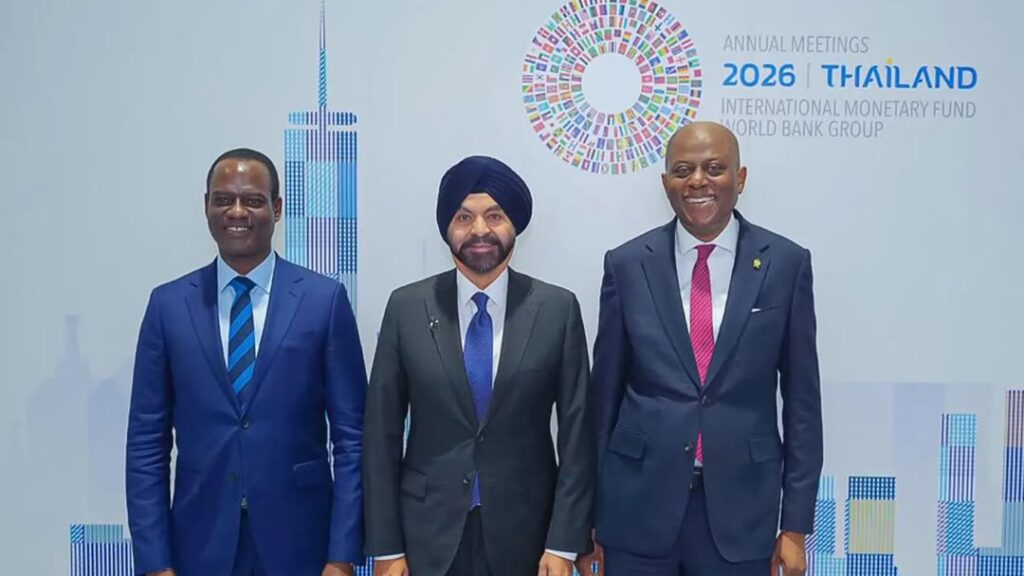
The World Bank and the International Monetary Fund (IMF) have called for a more strategic approach to artificial intelligence adoption, warning that poorly managed deployment of the technology could deepen inequality and weaken job creation, particularly in developing economies.
The warning came as Nigeria’s delegation, led by the Minister of Finance and Coordinating Minister of the Economy, Taiwo Oyedele, engaged international stakeholders and investors on the country’s economic reforms and investment opportunities at the ongoing annual meetings of the IMF and World Bank in Bangkok, Thailand.
The discussions placed employment at the centre of the global economic agenda, with officials emphasising that technological progress must translate into productive work, stronger businesses and improved living standards rather than benefits concentrated among a limited segment of society.
World Bank Group President Ajay Banga advocated practical applications of artificial intelligence that address specific development challenges and improve productivity across key sectors. He identified agriculture, primary healthcare, tourism, infrastructure and manufacturing as areas where targeted AI solutions could support businesses, expand economic activity and create employment.
Banga stressed that developing countries must establish the right conditions for private investment, including reliable infrastructure, effective governance and reduced investment risks. He maintained that governments have a responsibility to create an enabling environment in which businesses can expand and generate jobs.
He also highlighted the scale of the demographic challenge facing developing economies, noting that approximately 1.2 billion young people would reach the age of 18 over the next 15 years. He said this population growth could become an economic advantage if countries invested adequately in healthcare, education and relevant skills.
According to Banga, employment should not be limited to conventional salaried positions. Entrepreneurship and other productive activities that allow people to earn a decent living should also form part of efforts to expand economic opportunities.
Singaporean President Tharman Shanmugaratnam, who participated in the discussions, cautioned that economic growth alone would not necessarily produce enough quality jobs. He pointed to the possibility of economies expanding without a corresponding increase in employment opportunities, warning that artificial intelligence could intensify the problem if governments failed to prepare workers for changes in the labour market.
Tharman called for stronger skills development and policies that help workers build sustainable careers as technology reshapes industries. He identified manufacturing, green energy and healthcare as sectors with potential to support the creation of well-paying jobs.
The IMF Managing Director, Kristalina Georgieva, also raised concerns about the implications of artificial intelligence for public finances. She explained that governments traditionally rely significantly on income generated through labour and related economic activities to fund public services and social protection.
If AI adoption reduces the relative contribution of labour while increasing returns on capital, governments may need to reconsider how they generate sufficient revenue to support workers and manage the social consequences of technological change.
The concerns reflect a broader debate about how countries can benefit from advances in artificial intelligence without allowing productivity gains to widen income disparities or undermine employment prospects for younger workers.
For Nigeria, the discussions provided an opportunity to present its economic reform programme and attract investment into sectors capable of supporting long-term growth. The delegation’s engagements with international financial institutions and investors focused on fiscal reforms, foreign exchange market changes and the opportunities these developments could create for businesses.
The government is seeking to strengthen investor confidence and position the country as a destination for capital capable of supporting economic expansion. However, the broader challenge remains ensuring that investment translates into productive enterprises, sustainable employment and improved household incomes.
The debate over artificial intelligence is particularly relevant to developing economies, where young populations are entering the labour market while access to quality education, digital infrastructure and specialised skills remains uneven.
Although AI can help businesses reduce costs, improve decision-making and increase output, its benefits may be limited where electricity supply, internet connectivity and digital skills are inadequate. Without deliberate policies to address these barriers, the technology could benefit well-resourced businesses and workers while leaving vulnerable groups further behind.
The World Bank and IMF’s position underscores the need to balance innovation with inclusive economic planning. Rather than adopting technology simply to keep pace with global trends, countries are being encouraged to identify practical uses that respond to local needs and strengthen domestic productive capacity.
For Nigeria, converting investor interest and technological advances into broad-based prosperity will require more than economic reforms and digital adoption. It will also depend on reliable infrastructure, workforce development, effective institutions and an investment climate that allows businesses to grow.
As global leaders continue to assess the future of work, the central question is how countries can harness artificial intelligence to raise productivity while ensuring that economic progress creates meaningful opportunities for the people who need them most.
You must be logged in to post a comment.