
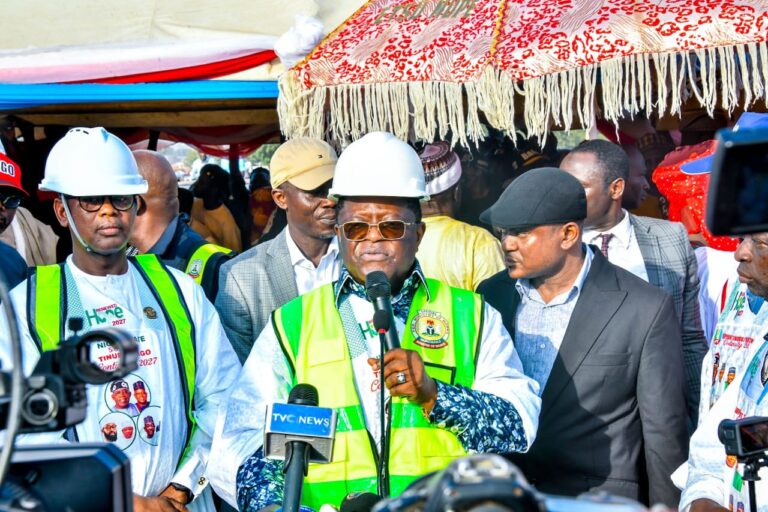
The Federal Government has commenced the reconstruction and dualisation of the 401-kilometre Lambata–Bida–Mokwa–Makera–Kontagora Federal Highway in Niger State, with the project valued at ₦1.8 trillion.
The groundbreaking ceremony took place on Tuesday, October 13, as part of the government’s ongoing efforts to improve road infrastructure, strengthen transportation networks and stimulate economic activities across the country.
Minister of Works, David Umahi, said the project would be executed through the Federal Government’s infrastructure tax-credit scheme in partnership with the Dangote Group. The highway will feature reinforced concrete pavement, an approach the government expects to provide a durable alternative to conventional asphalt roads.
Umahi described the highway as a potential fifth legacy road project of President Bola Tinubu’s administration, citing its scale, construction method and strategic importance to transportation and commerce. He commended the President for approving the project, noting that infrastructure development remained central to the administration’s economic agenda.
According to the minister, the Federal Government is executing approximately 5,500 kilometres of new and ongoing road projects nationwide, with Niger State accounting for about 1,055 kilometres. He also disclosed that 162 kilometres of roads and sections of bridges had been completed in the North-Central region.
Umahi said the administration had expanded some major road projects to improve connectivity between regions. He cited additional kilometres approved for the Lagos–Calabar Coastal Highway and the Akwanga–Jos–Bauchi–Gombe–Biu–Maiduguri road corridor, explaining that the extensions were intended to strengthen existing transport links.
Niger State Governor Mohammed Umaru Bago welcomed the highway project, describing it as an important intervention for communities and businesses across the state. He said improved road infrastructure would support the movement of people and goods while encouraging further economic development.
The Minister of Information and National Orientation, Mohammed Idris, also described the project as a major step towards expanding economic activity in Niger State. He said the improved road network would strengthen connections between communities, commercial centres and agricultural production areas.
Representing the Dangote Group, the company’s special adviser, Mansir Ahmed, said the group was pleased to participate in the project through the infrastructure tax-credit scheme. He described the highway as a strategic economic corridor and expressed confidence that its completion would create opportunities for businesses and young people.
Ahmed added that improved transportation would help farmers move produce to markets more efficiently and facilitate the distribution of food and other goods across regions. The highway is also expected to reduce travel delays and improve access to commercial destinations along its route.
The project received support from lawmakers overseeing works-related matters. Senate Committee on Works Chairman Allwell Onyesoh and House of Representatives Committee on Works Chairman Akin Alabi expressed support for efforts to improve the country’s road infrastructure and pledged legislative backing for the execution of such projects.
Niger traditional ruler and Chairman of the Niger Council of Traditional Rulers, Yahaya Abubakar, the Etsu Nupe, also welcomed the development, describing the highway as a significant investment in the state’s future. Community members expressed hope that the project would improve access to services, create economic opportunities and accelerate development in areas along the corridor.
When completed, the dual carriageway is expected to strengthen road connections across Niger State and improve the movement of agricultural produce, commercial goods and passengers. Its long-term impact, however, will depend on timely delivery, construction quality and effective maintenance.
The commencement of the project adds to the Federal Government’s wider infrastructure programme, with the Lambata–Bida–Mokwa–Makera–Kontagora route positioned as an important link for regional trade and economic activity. Attention will now turn to the pace of construction and the government’s ability to deliver the project as planned.
The report is based on coverage of the October 13 groundbreaking ceremony and statements by government officials and the Dangote Group.
You must be logged in to post a comment.