
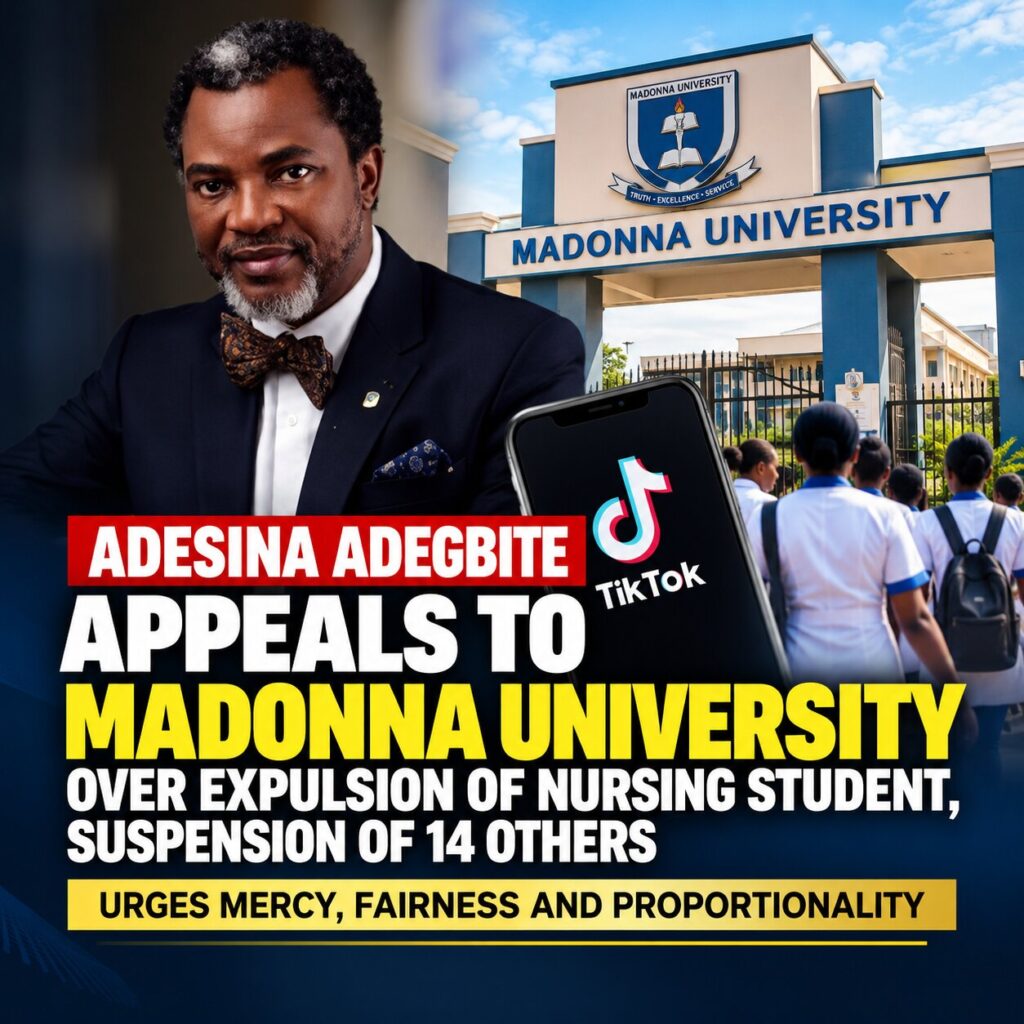
Former General Secretary of the Nigerian Bar Association (NBA) and Secretary General of the West African Bar Association (WABA), Adesina Adegbite, has appealed to the management of Madonna University to reconsider the reported expulsion of a final-year nursing student and suspension of 14 others over a viral TikTok video. Adegbite urged the university to temper discipline with mercy, fairness and proportionality, warning that the sanctions could have lasting consequences for the students’ academic and professional futures.
A PLEA FOR MERCY, FAIRNESS AND PROPORTIONALITY: AN APPEAL TO THE MANAGEMENT/GOVERNING COUNCIL OF MADONNA UNIVERSITY TO RECONSIDER THE EXPULSION AND SUSPENSION OF 15 NURSING STUDENTS
The news of the 15 Nursing students of Madonna University have dominated both the traditional news media and the social media in the past few days. I had to search for the said video earlier today to enable me form an informed opinion on the matter. Having seen the viral TikTok video of the GenZ Nursing students, I was moved to directly lend my voice to the burning issue, by respectfully appealing to the Management of Madonna University, to reconsider its reported decision to expel a final-year Nursing student and suspend 14 other 500-level students.
This appeal is borne out of a deep concern for the future of the affected students and a firm conviction that the administration of discipline in an institution of higher learning must be guided not only by the need to enforce rules but also by the principles of fairness, proportionality, compassion, and the preservation of human dignity.
At the outset, I acknowledge the right and responsibility of the University to maintain discipline, uphold its institutional values, and enforce its regulations. No institution of learning can function effectively without rules, and no student should be exempt from the consequences of established misconduct. However, the exercise of disciplinary authority must be measured against the nature of the alleged offence, the circumstances in which it occurred, and the consequences of the punishment imposed.
The fact that an institution possesses the power to punish does not necessarily mean that the harshest available punishment is the most appropriate.
The reported expulsion of a final-year Nursing student is particularly distressing. At this advanced stage of her academic journey, the student would ordinarily have invested years of sacrifice, commitment, examinations, clinical training, and personal discipline towards qualifying as a nurse. Behind that aspiration may also lie the considerable financial sacrifices, hopes, and expectations of parents and guardians who have laboured to give her an opportunity to build a professional future.
To bring that journey to an abrupt end through expulsion is a decision with consequences that may extend far beyond the immediate disciplinary circumstances.
Similarly, the suspension of 14 other 500-level students raises legitimate concerns about the academic, financial, emotional, and professional implications for young people who are reportedly approaching the completion of their university education.
I do not suggest that the students should be absolved of responsibility if their conduct has been established to violate the University’s regulations, neither do I seek to prejudge the facts surrounding the viral video. Rather, I respectfully submit that the gravity of the sanctions makes a careful reconsideration imperative.
A viral video should not become a life sentence on the academic and professional aspirations of young people.
Social media has become an influential feature of contemporary society, particularly among young people. Its misuse may warrant serious disciplinary intervention, especially where institutional rules or the dignity of others have been violated. Students must learn that freedom of expression and participation in online trends do not place them above the rules of their institution.
Nevertheless, the appropriate response to misconduct must be determined by a fair assessment of the facts, the individual responsibility of each student, the applicable regulations, and the proportionality of the proposed sanction. The fact that a video has gone viral should not, in itself, determine the severity of the punishment.
It is important to distinguish between discipline that corrects and discipline that permanently forecloses opportunity. The former seeks to reform the individual and prevent a recurrence of misconduct; the latter risks imposing consequences that may be disproportionate to the wrongdoing established.
Madonna University is not merely a place where students acquire academic qualifications, it is an institution entrusted with the development of character, judgment, responsibility, and sound values. Its disciplinary decisions should therefore reflect the highest ideals of education; firmness in principle, fairness in procedure, and humanity in execution.
Indeed, the ability to temper authority with compassion is not a sign of weakness. It is an indication of mature leadership.
Many serious minded people even outside the University commuity consider and agree that the conduct of the affected students is unacceptable. Apparently the sledgehammer approach of the university should be a wakeup call amongst the Gen-Zs who now romance the social media to the detriment oftheir academics. This excessive patronage of social media is currently a subject of sanctions even amongst law school graduates who are aspirants to be Bar. However, sanctions could take other forms which may include formal apologies, written undertakings, counselling, disciplinary probation, or a reduced period of suspension. Such measures can communicate the seriousness of the alleged misconduct without necessarily destroying the students’ prospects of completing their education.
This is particularly important in the case of the final-year Nursing student. Where there are no compelling circumstances that make expulsion unavoidable, I respectfully urge the University to consider allowing her to complete her programme, subject to appropriate disciplinary conditions.
Nursing is a profession that demands discipline, maturity, compassion, and responsibility. If the incident has exposed a lapse in judgment, the University has an opportunity to turn it into a profound lesson in accountability and professional conduct. The student’s remaining period of training could become an opportunity for reflection, correction, and renewed commitment to the ethical standards of the profession.
The same consideration should extend to the 14 other affected students. Their cases should be reviewed individually, rather than treated as indistinguishable, to ensure that the sanction imposed on each student reflects the person’s actual conduct and degree of responsibility.
It would be unfortunate if an incident that could have been addressed through corrective discipline were to result in the disruption of 15 academic journeys, with consequences for the students and their families that could endure for years.
Education should open doors to the future; disciplinary action should not close those doors permanently where a proportionate alternative is available.
I therefore respectfully call upon the Vice-Chancellor, the Governing Council, the Senate, and the relevant disciplinary authorities of Madonna University to demonstrate the University’s commitment to justice, fairness, and the future of its students by taking the following steps:
- Reverse the reported expulsion of the final-year Nursing student and permit her to complete her programme, subject to a fair review of the circumstances and any reasonable disciplinary conditions.
- Review the suspension of the 14 other 500-level students, with a view to lifting or reducing the sanctions where appropriate and permitting them to resume their studies.
- Consider corrective and restorative disciplinary measures that uphold the University’s standards while allowing the affected students an opportunity to learn from the incident and demonstrate improved conduct.
- Ensure that the affected students are afforded a fair opportunity to be heard and to seek a review of the disciplinary decisions in accordance with the University’s applicable regulations.
This appeal is not an invitation to the University to abandon discipline, its a call for discipline to be administered with wisdom, balance, and compassion.
There is a fundamental difference between holding a student accountable for an error of judgment and allowing that error to define the entirety of the student’s future. Universities should be places where young people are prepared not only for success but also for the responsibilities and challenges of adult life. That preparation necessarily includes learning from mistakes, accepting consequences, and being given a reasonable opportunity to make amends.
The management of Madonna University now has an opportunity to demonstrate that institutional authority and compassion can coexist. A decision to reconsider these sanctions would not necessarily diminish the University’s authority, rather, it could reinforce the understanding that discipline is most effective when it is fair, proportionate, and directed towards rehabilitation.
I respectfully appeal to the University’s management to rise above the understandable desire to make an example of the affected students and instead embrace an approach that preserves institutional discipline while safeguarding their educational future. I make this special appeal bearing in mind the significance of today, the 11th day of October, being the United Nations designated Day to celebrate and honour the Girl Child.
In the final analysis, the greatness of an educational institution is reflected not only in the standards it sets or the rules it enforces, but also in the wisdom, fairness, and humanity with which it administers discipline.
Mercy in this instance would not be a surrender of authority. It would be an affirmation of the true purpose of education. We have witnessed in recent times several cases of suicides being committed by young persons. That the students, particularly the one that was expelled could suffer depression is a high possibility. This is a consequence that even the University may not recover from immediately.
I sincerely hope that the management of Madonna University will give this appeal favourable consideration in the overriding interest of justice, education, mental health and the future of the affected students.
Thank you.
Adesina Adegbite, FICMC, MCIArb
Principal Partner, Adereti Adegbite & Co.
Past General Secretary, Nigerian Bar Association
Secretary General, West African Bar Association
You must be logged in to post a comment.