
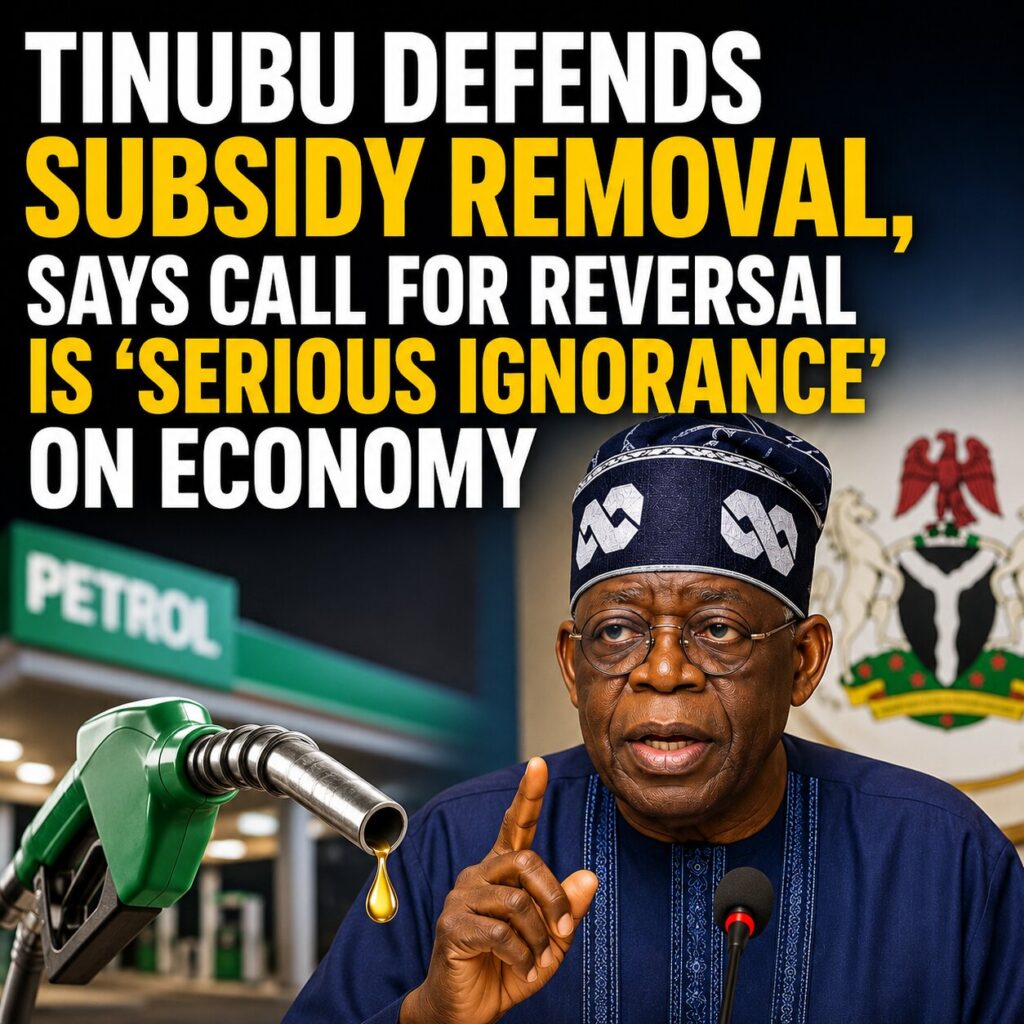
President Bola Tinubu has defended his administration’s decision to remove the petrol subsidy, dismissing calls for its restoration as a reflection of what he described as “serious ignorance” about the workings of the Nigerian economy.
Tinubu maintained that the subsidy regime had become unsustainable and that its removal was necessary to address structural weaknesses in the country’s finances and create room for longer-term economic stability.
The President has consistently argued that the policy, introduced at the beginning of his administration in May 2023, was not an easy political choice but one demanded by Nigeria’s fiscal realities. He has similarly defended other major economic measures, including foreign exchange reforms, as necessary steps towards correcting longstanding distortions in the economy.
Although the reforms initially triggered sharp increases in living and operating costs, with households and businesses contending with inflation and reduced purchasing power, the administration insists that reversing the subsidy removal would amount to returning the country to a system that placed enormous pressure on public finances.
Tinubu’s position comes amid continuing public debate over the impact of the policy on ordinary Nigerians. Critics have pointed to the cost-of-living pressures that followed the removal, while the Federal Government maintains that the previous arrangement diverted resources that could otherwise be channelled towards infrastructure and other areas of development.
The Presidency has argued that ending the subsidy freed resources for the different tiers of government and contributed to improved public revenues, while maintaining that recent economic indicators are beginning to demonstrate the benefits of the wider reform programme.
The debate over subsidy removal has remained one of the defining economic issues of the Tinubu administration, particularly as Nigerians continue to weigh the government’s claims of improving macroeconomic conditions against the everyday impact of prices, transportation costs and household expenditure.
For the President, however, returning to the former subsidy arrangement is not the solution. His position remains that Nigeria must sustain the reforms and address their consequences rather than reverse policies which the administration considers fundamental to rebuilding the economy.
You must be logged in to post a comment.