
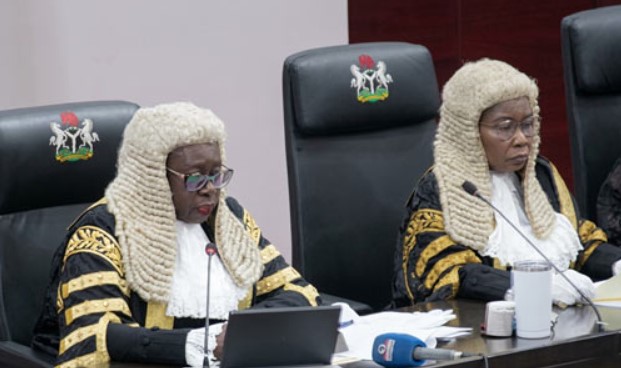
The PUNCH Editorial Board has urged the Nigerian judiciary to undertake far-reaching reforms and strengthen accountability, warning that the reported United States visa restrictions imposed on members of a Supreme Court panel should serve as a wake-up call for the institution.
In an editorial published on November 26, 2026, the newspaper said the disclosure by retired Supreme Court Justice Uwani Abba-Aji had renewed concerns about the reputation of the apex court and public confidence in judicial decisions.
Abba-Aji had revealed during her valedictory session that members of a Supreme Court panel were subjected to US visa restrictions following a controversial judgment delivered while she was on the bench. She reportedly described the decision as having been widely misinterpreted.
However, PUNCH argued that describing the judgment as misunderstood was insufficient to address the broader questions raised by the development. It maintained that judicial authority does not place court decisions beyond legitimate public scrutiny.
The editorial revisited several controversial decisions that have generated public debate, including the disputes surrounding the 2023 senatorial elections involving Godswill Akpabio and Ahmad Lawan.
It also recalled the Supreme Court’s January 14, 2020 judgment that removed Emeka Ihedioha as Imo State governor and declared Hope Uzodimma the winner after votes from 388 polling units were added to his tally.
According to the newspaper, controversies surrounding such decisions have reinforced public perceptions that electoral contests are increasingly determined through litigation rather than at the ballot box.
PUNCH further recalled the dissenting position of the late Justice Centus Nweze, who opposed the Supreme Court’s refusal to review the Imo governorship judgment, warning of its potential consequences for the country’s electoral jurisprudence.
The editorial also cited the Supreme Court’s decision to set aside the 12-year conviction of former Abia State Governor, Orji Uzor Kalu, on jurisdictional grounds and order a retrial after finding that the trial judge lacked jurisdiction following his elevation to the Court of Appeal.
Beyond controversial judgments, the newspaper expressed concern over what it described as the growing closeness between some judicial officers and political authorities.
It recalled the criticism that followed the attendance of then Acting Chief Justice of Nigeria, Tanko Muhammad, and other judicial officers at an Iftar dinner hosted by former President Muhammadu Buhari while presidential election petitions were pending.
Emphasising the need to protect public confidence in the courts, PUNCH stated that justice must not only be done but must also be seen to be done.
The newspaper called on the National Judicial Council (NJC) to strengthen its investigative capacity and ensure that allegations of judicial misconduct are thoroughly examined. It also advocated transparent and firm disciplinary measures whenever wrongdoing is established.
It stressed that no judicial officer should be shielded from scrutiny because of seniority, influence or political connections.
On judicial appointments, the editorial proposed structural changes to reduce political influence in the selection of key judicial officers, including the Chief Justice of Nigeria, President of the Court of Appeal and chief judges.
It recommended the establishment of an independent and broadly representative judicial appointments commission to identify, screen and recommend candidates based on competence, integrity and professional merit.
The newspaper also advocated meaningful public participation in the appointment process, while insisting that such reforms must preserve judicial independence.
With the 2027 general elections approaching, PUNCH urged the Supreme Court and the wider judiciary to undertake serious institutional reflection, warning that the credibility of the elections would depend not only on the Independent National Electoral Commission but also on the integrity of courts handling electoral disputes.
It cautioned that doubts about judicial integrity could weaken democratic institutions, erode confidence in the rule of law and discourage investment.
Concluding, the editorial maintained that the prestige of the judiciary cannot be sustained merely by constitutional status or the privileges attached to judicial office.
Rather, it said judicial respect must be earned through impartiality, courage, transparency and fidelity to the law.
You must be logged in to post a comment.