
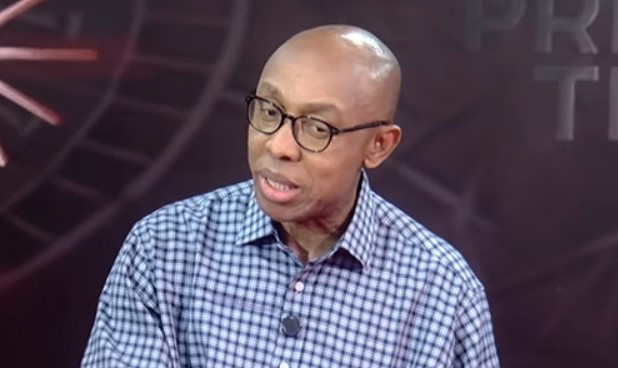
Human rights lawyer and former Chairman of the National Human Rights Commission, Professor Chidi Anselm Odinkalu, has criticised Justice Hyeladzira Nganjiwa of the Federal High Court, Warri, over a judgment restraining former Deputy Senate President, Senator Ovie Omo-Agege, from presenting himself as the Nigeria Democratic Congress (NDC) candidate for Delta Central Senatorial District in the 2027 general elections.
Odinkalu questioned the judge’s continued service on the bench, accusing him of drawing the judiciary unnecessarily into partisan political disputes.
The 167-page judgment was delivered on November 24, 2026, in Suit No. FHC/WR/CS/120/2026, instituted by Alexander Osondu Akpodiete against the Independent National Electoral Commission (INEC), the NDC and Omo-Agege.
The case centred on the interpretation of Section 77(4), (5) and (6) of the Electoral Act 2026, particularly the statutory requirements governing political party membership registers and eligibility to participate in party primaries.
One of the questions before the court was whether a political party could lawfully allow a person whose name was not contained in its membership register submitted to INEC at least 21 days before its primary election to participate in the exercise.
In its final orders, the court restrained Omo-Agege, whether personally or through agents, privies, surrogates or other persons, from parading himself as the winner of the NDC senatorial primary or as the party’s candidate for Delta Central in the 2027 elections.
The court further directed that the parties bear their respective costs.
Reacting to the decision in a post on his X account, Odinkalu described the judgment as an example of what he considered unnecessary judicial involvement in partisan political controversies.
He said the decision raised serious questions about judicial accountability and the responsibility of institutions charged with overseeing the conduct of judicial officers.
“Nganjiwa should not be sitting as a judge,” Odinkalu declared, while criticising the judge’s continued presence in the judiciary.
The former NHRC chairman also revisited the history of complaints involving Justice Nganjiwa before the National Judicial Council (NJC), particularly proceedings connected with a complaint by the Economic and Financial Crimes Commission (EFCC).
Odinkalu claimed that findings made by the NJC in 2019 raised concerns about the judge’s continued exercise of judicial authority.
He further faulted the NJC leadership for allowing Nganjiwa to return to judicial duties after an approximately four-year absence, arguing that the technical basis for his return did not, in his view, address the concerns arising from the earlier findings.
He maintained that the latest controversy reinforced the need for stronger accountability within the judiciary and urged citizens to continue demanding transparency from institutions responsible for judicial discipline.
Odinkalu, however, acknowledged that many judicial officers continued to perform their duties under difficult conditions, but argued that controversies involving individual judges could undermine public confidence in the wider institution.
The dispute before the Federal High Court arose from questions about compliance with the Electoral Act 2026 and the requirements for participation in political party primaries.
While the court’s judgment imposed restrictions on Omo-Agege’s claim to the NDC ticket, Odinkalu’s reaction focused largely on the judge’s conduct and the broader implications for judicial independence, political litigation and accountability.
His criticisms represent his assessment of the judgment and Justice Nganjiwa’s judicial record; they do not, by themselves, determine the legal merits of the court’s decision.
You must be logged in to post a comment.