
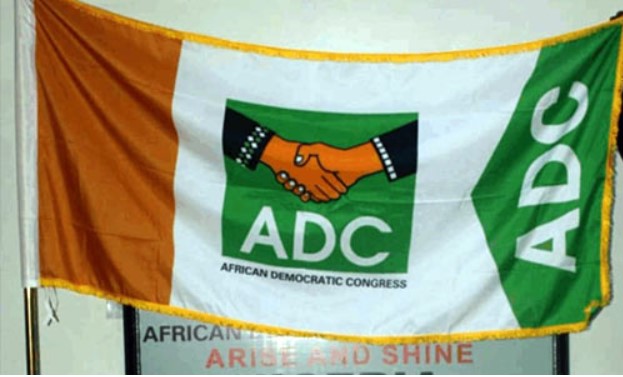
The African Democratic Congress (ADC) has approached the Court of Appeal in Abuja to challenge the Federal High Court judgment recognising Hon. Nafiu Bala Gombe in the party’s leadership dispute and nullifying the emergence of Senator David Mark and Ogbeni Rauf Aregbesola as national officers.
In its appeal against the judgment delivered by Justice Peter Lifu on November 5, 2026, the party raised 17 grounds, arguing that the trial court lacked jurisdiction, improperly evaluated evidence and granted orders beyond the issues before it.
The ADC is also asking the appellate court to declare the entire proceedings null and void and set aside the judgment.
The dispute arose from the party’s 99th National Executive Committee (NEC) meeting held on July 29, 2025, at which the existing National Working Committee was dissolved and a new leadership structure emerged.
Gombe, a former National Deputy Chairman of the party, had challenged the process, claiming that he was entitled to assume the party’s leadership following the resignation of its former National Chairman, Chief Ralph Nwosu.
Justice Lifu ruled in Gombe’s favour, nullifying the resolutions of the disputed NEC meeting and declaring him the only elected member of the National Working Committee whose tenure remained valid. The court also restrained the Independent National Electoral Commission (INEC) from recognising the Mark-led leadership.
*ADC challenges court’s jurisdiction*
A central argument in the appeal is that the case concerned the internal leadership and administration of a political party, which the ADC says was not a matter for the Federal High Court to determine.
The party argued that joining INEC as a defendant and alleging failures in its monitoring responsibilities did not transform an internal leadership dispute into an independent statutory cause of action.
It maintained that the trial judge wrongly relied on provisions of the 1999 Constitution and the Electoral Act 2022 without establishing how the disputed party decisions violated the relevant laws.
The ADC also raised the doctrine of res judicata, arguing that substantially similar issues had previously been considered in an earlier Federal High Court case, suit number FHC/ABJ/CS/1637/2025, involving Leke Joseph Abejide and others.
According to the party, Justice M.S. Liman had dismissed that suit in July 2026, and Justice Lifu, being a judge of coordinate jurisdiction, could not disregard the earlier decision or effectively sit on appeal over it.
The party further accused the trial judge of failing to properly assess documentary evidence, including records of earlier NEC meetings, notices sent to INEC and the commission’s monitoring report.
It argued that the court wrongly treated the absence of evidence of voting at the disputed meeting as conclusive proof that the leadership arrangement was unlawful.
*Party faults amendment of originating summons*
The ADC has separately challenged a July 24, 2026 ruling which allowed Gombe to amend his originating summons while the party’s objection to the court’s jurisdiction remained unresolved.
It argued that the amendment altered the description and legal capacity in which Mark and Aregbesola were sued, without the required prior leave of court.
The party also contended that the trial court failed to consider the effect of the Electoral Act 2026, which came into force on February 18, 2026.
Relying on Section 83(5) of the new Act, the ADC argued that the law restricted judicial intervention in internal political party disputes, subject to the exceptions provided under the legislation.
It maintained that the amendment allowed in July improperly recast Gombe’s original case in a way that sought to avoid the statutory restriction.
The party therefore urged the Court of Appeal to set aside the amendment ruling and hold that the Federal High Court lacked jurisdiction to proceed with the matter.
*Disputes findings on INEC notice and party leadership*
The ADC also challenged the trial judge’s findings concerning the notice given to INEC before the disputed NEC meeting.
It said the judgment acknowledged that the commission received 25 days’ notice and monitored the meeting, whereas Section 82(1) of the Electoral Act 2022 required at least 21 days’ notice.
The party argued that the court failed to identify any specific defect in the notice before declaring INEC’s attendance, monitoring report and recognition of the affected officers invalid.
It further faulted the court for extending its orders beyond the particular NEC meeting in dispute, arguing that the declarations could affect other meetings of the party.
Another issue raised was the court’s recognition of Gombe as entitled to supervise the party’s affairs. The ADC argued that his tenure had expired on October 11, 2026, before the judgment was delivered on November 5.
It also complained that the trial judge failed to determine its contention that Gombe had not renewed his party membership for more than six months, as required by the party’s constitution.
The party further challenged the nullification of all actions taken by Mark, Aregbesola and other affected officers from July 29, 2025. It argued that the court failed to consider the legal effect of acts performed by persons occupying public or organisational offices under the de facto officer doctrine.
*Seeks reversal of judgment*
The ADC is asking the Court of Appeal to allow its appeal, declare the proceedings before the Federal High Court null and void for want of jurisdiction, set aside the November 5 judgment and award costs in its favour.
It is also urging the appellate court to use its powers under Section 15 of the Court of Appeal Act to determine the outstanding jurisdictional objection and dismiss Gombe’s suit.
The party’s legal team is led by Chief J.S. Okutepa, SAN, alongside Shaibu Enejoh Aruwa, SAN, and other counsel.
The appeal names Gombe, Mark, Aregbesola, INEC and Chief Ralph Nwosu as respondents.
The arguments contained in the appeal are the ADC’s grounds for challenging the judgment and remain subject to determination by the Court of Appeal.
The appeal also challenges the trial judge’s finding that Gombe’s resignation letter from the ADC was fictitious or fabricated. The party argued that Justice Lifu relied substantially on visual comparison of signatures without sufficient evidential foundation. It further contended that the disputed authenticity of the documents should have been resolved through oral evidence and cross-examination rather than affidavit evidence alone.
The ADC questioned Gombe’s legal standing to institute the action, arguing that he had resigned from both his position as Deputy National Chairman and membership of the party in May 2025. It also faulted the court for allegedly failing to consider whether he had exhausted the party’s internal dispute-resolution procedures before approaching the court.
On the amendment dispute, the party recalled that the Supreme Court, on April 30, 2026, had directed the Federal High Court to hear and determine all pending processes in the case. The ADC argued that Gombe’s application to amend his originating summons was filed on May 11, after the Supreme Court’s directive, and was therefore not among the pending processes covered by that order.
It accused the trial court of acting contrary to the apex court’s directive by entertaining the subsequent amendment.
The party also challenged the trial judge’s treatment of the disputed July 2025 NEC meeting, arguing that the court failed to determine whether the changes to the party’s leadership amounted to an election, the filling of vacancies or the establishment of an interim administrative arrangement under the ADC constitution.
The 17th ground of appeal states that the judgment was against the weight of evidence.
The appellate court is yet to determine the arguments raised by the party.
You must be logged in to post a comment.