
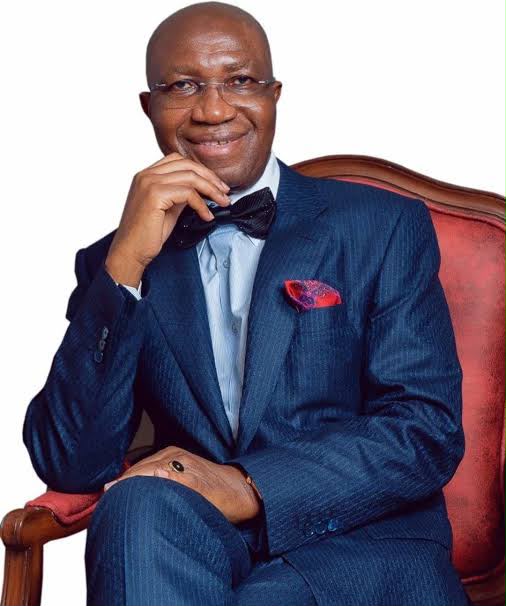
Some individuals distinguish themselves through the offices they occupy and the honours they receive; others earn enduring recognition through the quality of their contributions to society. Chief Wole Olanipekun, SAN, OFR, CFR, is an exceptional blend of both. His life and career reflect an uncommon convergence of intellectual depth, professional distinction, courage of conviction and an abiding commitment to the advancement of the legal profession and the larger society.
As he attains the remarkable age of 75 on November 18, 2026, We celebrate a man whose influence extends far beyond the courtroom and the distinguished positions he has occupied. He has shaped legal thought, strengthened professional institutions, inspired younger generations of lawyers and remained an influential voice in the continuing quest for justice, constitutionalism and national development.
My relationship with Chief Wole Olanipekun is one for which I remain profoundly grateful. I have come to know him not simply as the formidable Senior Advocate whose reputation precedes him, but as a mentor whose encouragement, generosity and confidence in younger professionals can make a defining difference in their careers. Behind his imposing professional stature is a man who recognises potential, encourages ambition and takes genuine satisfaction in seeing others rise.
I recall particularly the period when I was contemplating my journey to the Inner Bar. Chief Olanipekun was unequivocal in his encouragement. At one point, he observed that, given my age and experience at the Bar, I ought to be leading the team of lawyers appearing in court and not being led. He urged me to pursue the rank of Senior Advocate of Nigeria with greater determination and passion. Coming from a man of his standing, the observation was both affirming and challenging. When I eventually attained the rank of SAN, his happiness and congratulatory response meant a great deal to me. That experience captures one of his most admirable qualities: he does not merely celebrate excellence; he actively encourages its emergence in others.
My involvement in Egbe Amofin Oodua further deepened my appreciation of his character. He was a respected figure and adviser whose wisdom and experience members naturally looked up to. His commitment to the Yoruba cause was unmistakable, yet it was accompanied by a broader vision of a united Nigeria founded on justice, fairness and the rule of law. I also recall with gratitude his solid support when I contested for the position of Publicity Secretary of the Nigerian Bar Association
in 2008. Although he had only recently come to know me, he readily supported my aspiration. That gesture spoke volumes about his willingness to recognise and encourage merit without allowing the length of an acquaintance to become a barrier.
Perhaps one of the most remarkable things about Chief Olanipekun is his accessibility. Despite his stature and demanding professional engagements, whenever I have reason to call him, even when he was outside Nigeria, he has generally taken my call and responded promptly, particularly when I sought professional advice. This is no small gesture. It reflects a generosity of spirit and a commitment to mentorship that cannot be measured by titles or public accolades. He reminds younger practitioners that professional eminence should never become a barrier to human connection.
Born Oluwole Oladapo Olanipekun on November 18, 1951, in Ikere-Ekiti, Ekiti State, he received his early education at Amoye Grammar School and Ilesa Grammar School before proceeding to the University of Lagos, where he studied Law. Called to the Nigerian Bar in July 1976, he attained the prestigious rank of Senior Advocate of Nigeria in July 1991, at a remarkably young age. In 1980, he established Wole Olanipekun & Co., which has grown into one of Nigeria’s foremost law firms and a platform for nurturing generations of accomplished legal practitioners.
His advocacy is, in my estimation, among the finest expressions of forensic excellence in contemporary Nigerian legal practice. Chief Olanipekun does not merely argue cases; he constructs them. His approach to courtroom advocacy reminds me of the manner in which an engineer builds a structure: with careful planning, sound foundations, precision, balance and attention to every critical detail. He deploys illustrations, accurate diction, persuasive reasoning and compelling presentation to lead the court through the architecture of his argument. His submissions combine passion with intellectual discipline, eloquence with substance, and conviction with painstaking preparation.
To listen to him in court is to witness advocacy as both an intellectual exercise and an art form. He knows how to develop an argument, expose the weaknesses in an opposing position and bring the central issue into sharp focus. I have often regarded him as the Chief F.R.A. Williams of this generation, a comparison that reflects the extraordinary place he occupies in the imagination of the Nigerian Bar.
His professional practice has traversed constitutional law, electoral litigation, commercial disputes, arbitration, criminal law and other complex areas, earning him recognition as one of the country’s most formidable advocates. His service to the profession has been equally distinguished. As President of the Nigerian Bar
Association from 2002 to 2004, he led the Bar at a period when the independence of the judiciary and the integrity of the legal system demanded sustained attention. He subsequently became a Life Bencher and served as Vice-President of the Pan African Lawyers Union. His contributions to public service included serving as Attorney-General and Commissioner for Justice of Ondo State from 1991 to 1992, as well as serving in the governing councils of prominent universities. His appointment in 2024 as Pro-Chancellor and Chairman of the Governing Council of the University of Lagos brought him back to the institution where his own academic journey in law began.
One particularly defining episode of his NBA presidency was his resolute response to the assassination of two members of the profession, Barnabas Chidi Igwe, then Chairman of the NBA, Onitsha Branch, and his pregnant wife, Abigail Amaka Igwe, also a legal practitioner and his partner in chambers. The couple were murdered in Onitsha on September 1, 2002, shortly after returning from the NBA’s Annual General Conference in Ibadan. At a time when their killing sent shockwaves through the legal community and raised disturbing questions about the safety of those who dared to challenge abuses of power, Chief Olanipekun responded with remarkable urgency and institutional resolve. He convened an emergency meeting of the NBA’s national officers the following day, led a delegation to the Inspector-General of Police in Abuja to demand a thorough investigation and prosecution of those responsible, and mobilised the legal profession in a national expression of grief and solidarity, including the observance of a National Day of Mourning. The NBA’s intervention was extended to the highest levels of government, while a trust fund was established for the couple’s three children. These actions went beyond the customary condemnation of a heinous crime; they demonstrated a President determined to ensure that the lives of two members of the profession would not be reduced to another forgotten tragedy. Although the quest for justice remains unresolved, his response stands as an enduring testament to his courage and his defence of the Bar.
His presidency also demonstrated the independence of his convictions. Chief Olusegun Obasanjo, a fellow Yoruba man, was President of Nigeria at the time. Yet Chief Olanipekun did not allow ethnic affinity or personal considerations to temper his judgement. He remained outspoken against actions and tendencies of the Federal Government that offended the principles of the rule of law, constitutionalism and due process. He demonstrated that professional responsibility and national interest must take precedence over ethnic sentiment or political convenience. Under his leadership, the NBA asserted itself as a formidable voice in national affairs and, in the estimation of many, the conscience of the nation. His tenure remains a compelling illustration of principled leadership, institutional independence and professional courage.
His later emergence as Chairman of the Body of Benchers, becoming its 50th Chairman on March 31, 2022, was another recognition of the confidence reposed in him by the legal profession. He discharged the responsibilities of that distinguished statutory institution with admirable commitment and dignity, to the satisfaction and admiration of stakeholders.
Beyond his professional and public engagements, Chief Olanipekun is a man of deep religious and moral convictions. He is highly respected within the Anglican community, not because of any ostentatious display of religiosity, but because of the values reflected in his conduct and disposition. His life demonstrates the importance he attaches to integrity, uprightness, responsibility and ethical consistency. He exemplifies the understanding that genuine religious conviction is best demonstrated through the character one exhibits and the principles one upholds.
Equally worthy of admiration is his commitment to family life. For all his professional engagements and public responsibilities, he has remained a devoted family man. Two of his children have attained the rank of Senior Advocate of Nigeria, a remarkable achievement that reflects the values of discipline, intellectual development and professional excellence nurtured within the family. His legacy is therefore reflected not only in the institutions he has served, the cases he has argued and the lawyers he has mentored, but also in the family he has raised and the values transmitted to the next generation.
Another remarkable dimension of his contribution to public life is the exceptional quality of his speeches, invariably rich in wisdom, insight and intellectual depth. His interventions on matters of national importance often transcend the immediate occasion, offering thoughtful perspectives on the principles that underpin a just and orderly society. Indeed, his speeches deserve to be collated and preserved in a compendium that would serve as a valuable intellectual resource, not only for legal practitioners, but also for philosophers, scholars, public intellectuals, policymakers and members of the wider public. His reflections on individual freedoms, human rights, due process, legality, constitutionalism, the rule of law and good governance constitute a body of thought worthy of sustained study and engagement. Such a collection would preserve his intellectual contributions for posterity and make the wisdom of his public interventions accessible to generations yet unborn.
Chief Olanipekun’s contributions have earned him several honours and distinctions, including the national honours of Officer of the Order of the Federal Republic (OFR) and Commander of the Order of the Federal Republic (CFR), conferred in 2012 and 2022 respectively, alongside honorary academic distinctions and professional
recognitions. Yet, for all the honours and appointments, I believe the most meaningful measure of his life is the number of people he has inspired, encouraged and helped to advance.
A man may build a successful law firm, argue landmark cases, occupy distinguished public offices and receive national recognition. But when he also takes the time to encourage a younger lawyer, support an aspiring professional and offer guidance without regard to personal convenience, he creates a legacy far more enduring than any title.
This is the Chief Wole Olanipekun I have come to know: a man of formidable intellect and forensic brilliance; a passionate Advocate of justice and the rule of law; a proud son of Yoruba heritage and a committed believer in the Nigerian project; a mentor who recognises promise in others; and a professional whose generosity of spirit has enriched the lives and careers of many.
As he attains the age of 75, I celebrate not only the legal luminary whose name commands respect across Nigeria and beyond, but also the mentor whose words strengthened my professional resolve, the senior colleague whose support came when it mattered, and the accessible leader whose counsel remains invaluable.
My Dear Chief, your journey has been one of extraordinary accomplishment, but its greatest significance lies in the lives you have touched and the standards you have established. You have demonstrated that excellence is the product of preparation, discipline, courage and an unwavering commitment to one’s calling. You have also shown that true greatness is not diminished by helping others rise; it is enlarged by it.
On this occasion of your 75th birthday, I wish you continued good health, renewed strength, peace and many more years of purposeful service. May your wisdom continue to guide the profession, your advocacy defend the cause of justice, and your mentorship inspire generations of lawyers yet to come.
Happy 75th Birthday, my leader, Baba Egbe Amofin.
Muritala Abdul-Rasheed, SAN, Ph.D (Murray), is a former National Publicity Secretary of the Nigerian Bar Association (NBA).
You must be logged in to post a comment.