
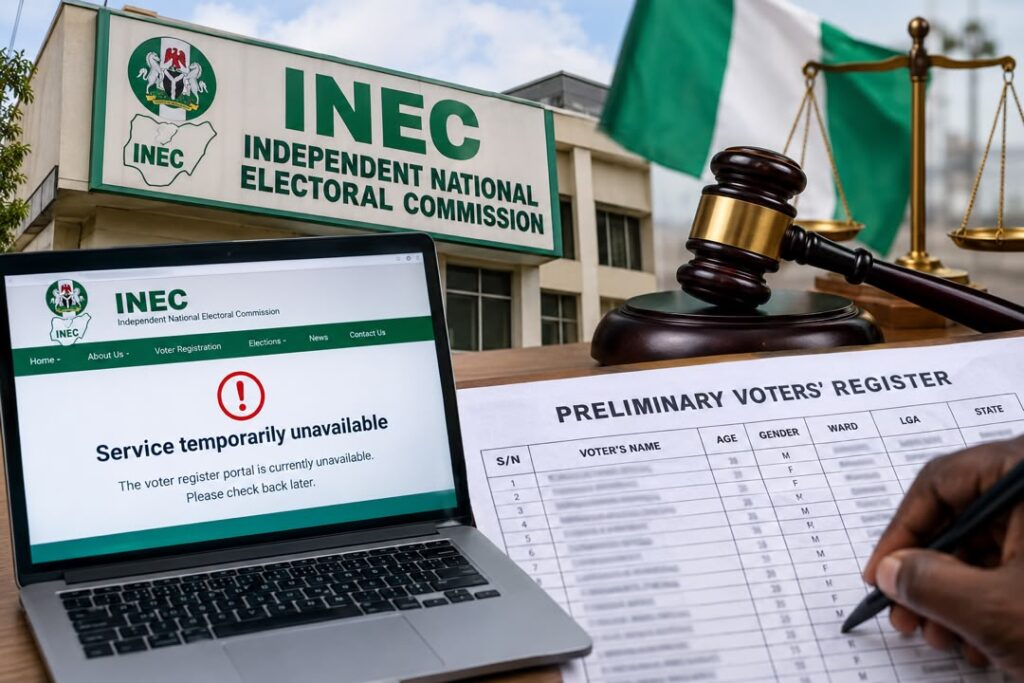
The Independent National Electoral Commission (INEC) is facing the threat of legal action over the alleged failure to make the preliminary voters’ register accessible online and concerns surrounding the redeployment of key electoral officials ahead of the 2027 general elections.
Concerned Citizens for Nigerian Democracy (CCND), a civic group, has threatened to approach the Federal High Court if the commission fails to publish the preliminary register online by October 30, 2026.
The group said it had written to INEC Chairman, Professor Joash Amupitan, over the matter and that the commission acknowledged receipt of its letter dated October 22.
CCND disclosed that an attempt to access INEC’s voter registration portal on October 21 returned a message stating, “Service temporarily unavailable,” preventing members of the public from examining the preliminary register.
The group maintained that online access was necessary to allow registered voters, political parties and other stakeholders to scrutinise the register and identify possible irregularities, including duplicate entries, deceased persons whose names remained on the register and questionable voter transfers.
It cited Section 19 of the Electoral Act 2026, which provides for public scrutiny of the preliminary voters’ register and a period for submitting claims and objections. The group warned that the opportunity to challenge inaccuracies would be undermined if the public could not adequately access the register.
The controversy follows INEC’s nationwide display of the preliminary register at registration areas between October 9 and 15, 2026. The commission’s online portal, however, was reportedly inaccessible during the period when members of the public sought to examine the records.
CCND also raised concerns over the redeployment of Mrs Oluyemi Titilayo Adeyemi-Showunmi to head INEC’s Electoral Operations Department at its Abuja headquarters, while the department’s former head, Isah Gummi, was moved to the Voter Registry Department.
The group questioned whether the redeployment could raise concerns about impartiality, noting that Adeyemi-Showunmi’s husband, Segun Showunmi, serves in the Media and Strategic Communications Directorate of the All Progressives Congress Presidential Campaign Council.
Meanwhile, former Vice-President Atiku Abubakar accused INEC of undermining public confidence in the 2027 elections over the alleged failure to make the voters’ register available online.
In a statement issued by Phrank Shaibu, Director of Strategic Communication of the African Democratic Congress Presidential Campaign Council, Atiku questioned the whereabouts of the register, which INEC reportedly said contained more than 103 million registered voters.
He argued that the register’s alleged unavailability during the October 9 to 15 inspection period deprived Nigerians of the opportunity to verify their details, identify omissions and challenge questionable entries.
Atiku also questioned conflicting accounts concerning when the register was displayed, referring to an alleged statement by INEC’s chairman on October 5 that the exercise had already been completed.
He further called for clarification on the procedures for determining the authenticity of ballot papers without INEC’s official mark, arguing that clear safeguards were necessary to prevent electoral fraud and enable political parties to challenge disputed ballots.
Beyond the controversy surrounding the voters’ register, INEC is exploring the use of artificial intelligence to reduce errors in election result management and strengthen the electoral process.
The commission’s Director of Information and Communication Technology, Lawrence Bayode, disclosed this at the launch of the AI for Elections Programme and Hackathon organised by Rise Networks in Abuja.
Bayode explained that the proposed system would compare figures entered electronically with those recorded on paper result sheets and scanned copies before permitting transmission. Where discrepancies are detected, they must be resolved before the results can be uploaded.
He said the technology could reduce human errors, improve operational efficiency and help ensure that figures published on INEC’s portal correspond with results recorded at polling units.
However, he cautioned that technological innovation must not compromise electoral security, operational stability or public confidence. He also urged developers to use publicly available or duly authorised data without compromising critical electoral infrastructure.
Meta’s Head of Public Policy for Anglophone West Africa, Sade Dada, warned that increasingly sophisticated artificial intelligence tools could make it more difficult for people to distinguish authentic information from manipulated content.
She identified cloned videos and synthetic voices as emerging threats to electoral integrity but noted that artificial intelligence could also support content verification, digital literacy and multilingual information services.
The presidential and National Assembly elections are scheduled for January 16, 2027, while governorship and State Houses of Assembly elections are scheduled for February 6, 2027.
You must be logged in to post a comment.