
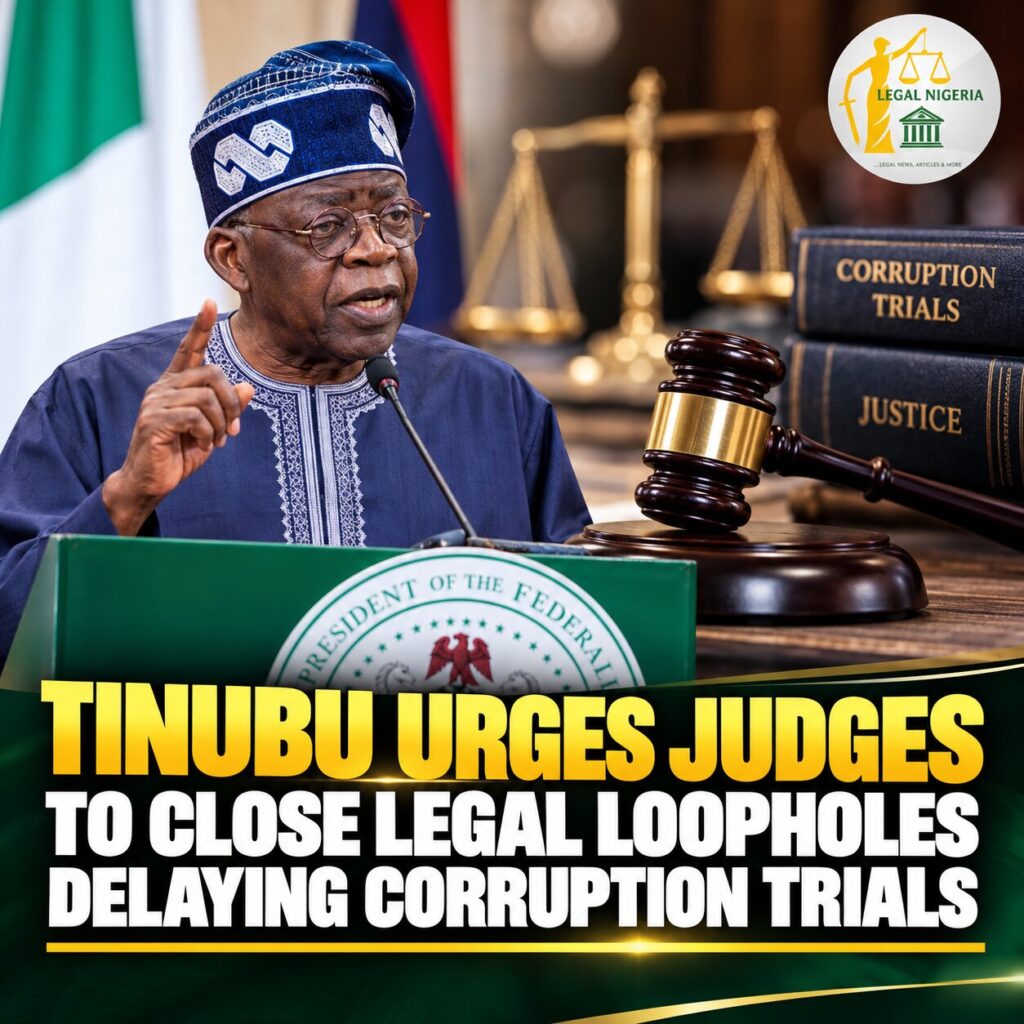
President Bola Tinubu has called on the Nigerian judiciary to address procedural loopholes and outdated legal practices that allow politically exposed persons and organised crime suspects to delay or frustrate corruption trials.
Tinubu made the call on Tuesday, October 13, 2026, in Abuja, during the eighth annual Capacity Building Workshop for Judges and Justices, organised by the Economic and Financial Crimes Commission (EFCC) in collaboration with the National Judicial Institute (NJI).
The President, who was represented by Vice President Kashim Shettima, stressed that Nigeria’s anti-corruption efforts would remain ineffective without an independent, progressive and reform-minded judiciary capable of responding to emerging challenges in the administration of criminal justice.
He urged judicial officers to critically examine existing prosecution strategies, reconsider outdated legal precedents and address procedural weaknesses frequently exploited to obstruct criminal proceedings.
According to Tinubu, the justice system must not allow legal technicalities to become instruments through which individuals evade accountability.
He maintained that corruption poses a serious threat to Nigeria’s development and should not be regarded as a problem for the executive arm of government alone, noting that its consequences extend to the legislature, judiciary and ordinary citizens.
The President emphasised that the courts must uphold both the letter and spirit of the law while ensuring that judicial processes serve the broader public interest.
Speaking on the workshop’s theme, “Investigation and Prosecution of Economic and Financial Crimes in a Digital Age,” Tinubu observed that technological advancements have significantly transformed the nature of financial crimes.
He identified artificial intelligence, blockchain technology and cryptocurrency-related activities as developments presenting increasingly complex challenges for investigators, prosecutors and judicial officers.
Tinubu consequently called for continuous professional development and stronger institutional capacity to enable the judiciary and law enforcement agencies to respond effectively to technology-driven financial crimes.
He also acknowledged the EFCC’s efforts in combating financial crimes, including the recovery of digital assets linked to fraudulent investment activities.
The President commended the Chief Justice of Nigeria, Justice Kudirat Kekere-Ekun, for ongoing efforts to strengthen the judiciary and pledged the Federal Government’s support for reforms aimed at improving justice delivery.
In her remarks, Justice Kekere-Ekun noted that technological developments had changed the manner in which digital evidence is collected, documented and presented before courts.
She emphasised the importance of effective case management and continuous judicial training in ensuring that judicial officers remain equipped to handle increasingly sophisticated financial crime cases.
The Attorney-General of the Federation and Minister of Justice, Lateef Fagbemi, SAN, represented by the Director of Public Prosecutions, Rotimi Oyedepo, SAN, called for greater cooperation among relevant institutions in the fight against corruption.
Fagbemi stressed that effective investigation and prosecution of economic crimes require coordinated efforts by law enforcement agencies, prosecutors and the judiciary.
Also speaking, the Chairman of the EFCC, Ola Olukoyede, described the workshop as an important platform for strengthening the administration of criminal justice.
Olukoyede said the commission had recorded significant convictions and asset recoveries over the past three years, while acknowledging that technological innovations were developing faster than some existing legal frameworks for investigating and prosecuting financial crimes.
He assured participants of the commission’s commitment to the transparent management of recovered funds and assets.
The workshop brought together judicial officers and other stakeholders to examine practical approaches to strengthening the investigation, prosecution and adjudication of economic and financial crimes in Nigeria.
The President’s remarks have renewed attention on the need to balance efficient criminal proceedings with the constitutional safeguards that protect the rights of accused persons, including the right to a fair hearing.
You must be logged in to post a comment.