
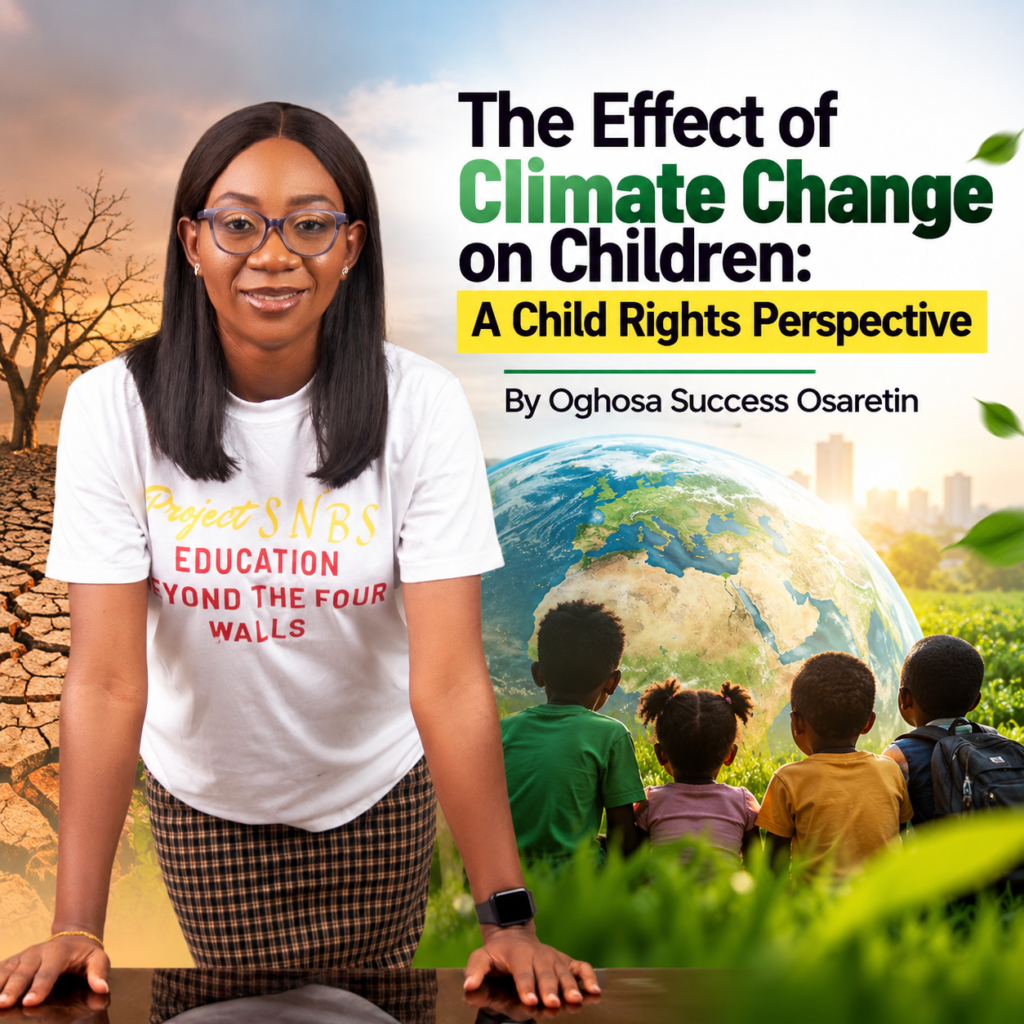
Climate change simply means long-term changes in the Earth’s temperature and weather patterns.Think of it this way: When the Earth becomes warmer than normal over a long period, it can lead to more heat, flooding, drought, rising sea levels and changes in rainfall.
Human activities such as burning petrol and gas, cutting down trees and pollution contribute significantly to climate change. And yes, climate change affects children too—from the food we eat and water we use to our health, education and future. The Earth is our home. Protecting it is everyone’s responsibility, hence this article.
Climate change is often discussed as an environmental or economic issue, but its consequences reach directly into the lives of children. Floods, extreme heat, drought, food insecurity, pollution, displacement and disease can affect a child’s health, education, safety, development and overall well-being.
For this reason, climate change should also be understood as a child-rights issue.
The United Nations Committee on the Rights of the Child, in General Comment No. 26 (2023), expressly recognises the climate emergency, biodiversity loss and pollution as systemic threats to children’s rights. (Digital Library)
Children Are Particularly Vulnerable
Children are uniquely vulnerable to climate-related harm because their bodies and physiological systems are still developing. They also depend heavily on adults and public services for food, healthcare, education, safe water and protection.
In Nigeria, UNICEF’s Climate Landscape Analysis for Children in Nigeria identifies children as disproportionately affected by climate change because of their dependence on others, greater susceptibility to disease and malnutrition, exposure to environmental hazards and developmental needs, including access to education and nutritious food. (UNICEF)
The effects become more severe where climate shocks intersect with poverty, inadequate infrastructure, conflict and displacement.
1. Impact on Children’s Health
Climate change can increase children’s exposure to extreme heat, infectious diseases, air pollution and unsafe water.
The IPCC reports that children are particularly vulnerable to climate-related health risks because of their immature physiology and metabolism. Climate change can increase risks of malnutrition and infectious diseases, particularly where households already face limited access to food, clean water and healthcare. (IPCC)
In Nigeria, UNICEF identifies flooding, drought and rising temperatures as threats to children’s health and nutrition. Pollution also increases risks of gastrointestinal, respiratory and vector-borne diseases. (UNICEF)
2. Food Insecurity and Malnutrition
Climate change affects agriculture, food production and household livelihoods.
Drought, excessive rainfall and flooding can destroy crops and reduce household income. When food becomes scarce or more expensive, children may suffer from inadequate nutrition.
The IPCC projects increased risks of childhood undernutrition and stunting, particularly in Africa and Asia, as climate change affects food availability, dietary diversity and nutritional quality. (IPCC)
Malnutrition in childhood is particularly concerning because it can affect physical growth, cognitive development and educational outcomes.
3. Disruption of Education
Climate change can interfere with a child’s right to education.
Floods may destroy schools or make roads impassable. Extreme heat can make learning environments uncomfortable or unsafe, while displacement may separate children from their schools.
The IPCC notes that climate change can undermine educational attainment, particularly through its effects on livelihoods, food security and displacement. (IPCC)
UNICEF Nigeria’s 2025 Climate Change Education Handbook for Schools in Nigeria also recognises that climate change threatens clean air, safe water, nutritious food and safe shelter and can disrupt learning in schools. (UNICEF)
Thus, climate-resilient education infrastructure should be regarded as part of protecting children’s rights.
4. Water, Sanitation and Hygiene
Children require reliable access to safe water for drinking, hygiene and sanitation.
Drought can reduce water availability, while flooding can contaminate water sources and damage sanitation infrastructure.
UNICEF’s Nigeria analysis identifies water, sanitation and hygiene as among the essential services placed under pressure by climate-related hazards. (UNICEF)
A failure to provide resilient water and sanitation systems therefore has consequences far beyond environmental management—it directly affects children’s health and dignity.
5. Mental Health and Emotional Well-being
Climate-related disasters can be traumatic for children.
A child who loses a home, is displaced by flooding, witnesses destruction or experiences repeated environmental emergencies may experience fear, anxiety and psychological distress.
The IPCC reports that climate change can adversely affect mental health and that children and adolescents are particularly vulnerable to impacts associated with extreme temperatures, extreme weather events, displacement, conflict, economic losses and climate-related anxiety. (IPCC)
Climate adaptation must therefore include psychosocial support, not merely physical reconstruction.
6. Displacement and Child Protection
Climate change can contribute to displacement when floods, drought, desertification and other environmental pressures destroy homes and livelihoods.
Displacement can expose children to additional protection risks, including interruption of education, family separation, poverty, exploitation and insecurity.
UNICEF’s Nigeria analysis links climate pressures—including drought, flooding and desertification—with migration, conflict and displacement, all of which can impede children’s access to essential services and protection. (UNICEF)
For child-protection practitioners, this intersection between climate change, displacement and vulnerability deserves particular attention.
Climate Change as a Child Rights Issue
The Convention on the Rights of the Child protects a range of rights that can be affected by climate change, including rights connected with survival and development, health, education, protection and participation.
General Comment No. 26 is particularly important because the UN Committee on the Rights of the Child places environmental degradation and climate change within the framework of children’s rights. (Digital Library)
For Nigeria, this perspective also connects with the Child Rights Act 2003, which provides protections concerning children’s welfare, health, education and special protection. The National Human Rights Commission notes that the Child Rights Act domesticated the Convention on the Rights of the Child in Nigeria, although its application depends on state-level domestication. (Nigeria Rights Commission)
Nigeria’s Climate Change Act 2021 provides a broader legal framework for climate mitigation and adaptation, including identifying risks and vulnerabilities, building resilience and integrating climate action into national development. (Leap)
The Act also provides for the mainstreaming of climate change across sectors and includes climate change obligations involving public and private entities. (Leap)
What Should Be Done?
A child-centred climate response should include:
1. Climate-resilient schools
Schools should be designed and maintained to withstand flooding, extreme heat and other foreseeable climate risks.
2. Stronger health systems
Children need access to healthcare capable of responding to climate-sensitive diseases, malnutrition and heat-related illness.
3. Food and nutrition programmes
Climate adaptation should protect children’s access to nutritious food.
4. Safe water and sanitation
Investment in resilient WASH infrastructure is essential.
5. Protection of displaced children
Disaster and climate policies should include specific child-protection mechanisms.
6. Mental-health support
Children affected by climate disasters should have access to appropriate psychosocial care.
7. Climate education
Children should not merely be taught about climate change; they should be equipped with the knowledge and skills to participate in solutions. UNICEF’s 2025 Nigerian climate education handbook specifically promotes this approach. (UNICEF)
8. Children’s participation
Children and young people should have meaningful opportunities to contribute to decisions affecting their environmental future. General Comment No. 26 emphasises the importance of children’s participation in environmental matters. (Digital Library)
Conclusion
Climate change is not simply about temperatures, floods or carbon emissions.
It is about children.
It is about the child who cannot get to school because the road is flooded.
It is about the child whose family cannot afford food after a failed harvest.
It is about the child exposed to contaminated water or dangerous heat.
It is about the child displaced from home and community.
And it is about the generation that will live longest with the consequences of decisions made today.
As lawyers, policymakers, parents, educators and child-rights advocates, we must therefore move beyond asking “What is climate change doing to the environment?”
We must also ask:
“What is climate change doing to the Nigerian child—and what are we doing about it?”
The climate crisis is a child-rights crisis. Protecting children must therefore be at the centre of climate action.
References
- UNICEF, Climate Landscape Analysis for Children in Nigeria: Climate Action Plan 2023–2027 (2023). (UNICEF)
- UNICEF, The Climate Crisis Is a Child Rights Crisis: Introducing the Children’s Climate Risk Index (2021). (UNICEF)
- UNICEF, Children’s Climate Risk Report 2026 (2026). (UNICEF DATA)
- UN Committee on the Rights of the Child, General Comment No. 26 (2023) on Children’s Rights and the Environment, with a Special Focus on Climate Change, CRC/C/GC/26. (Digital Library)
- IPCC, Climate Change 2022: Impacts, Adaptation and Vulnerability, Chapter 7. (IPCC)
- IPCC, Climate Change 2022: Impacts, Adaptation and Vulnerability, FAQ 3. (IPCC)
- Federal Republic of Nigeria, Climate Change Act 2021. (Leap)
- Federal Republic of Nigeria, Child Rights Act 2003. (Federal Ministry of Education)
- Federal Ministry of Education/UNICEF Nigeria, Climate Change Education: Handbook for Schools in Nigeria(2025). (UNICEF)
Oghosa Success Osaretin
LL.B/BL, LL.M (Unilag)// ACIArb.
Lawyer | Author | Researcher | Child Rights Protection Advocate
LinkedIn: Success Oghosa Osaretin
You must be logged in to post a comment.