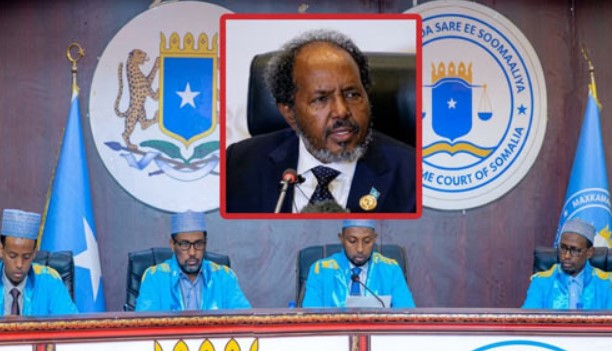
Somalia’s Supreme Court has ruled that President Hassan Sheikh Mohamud cannot remain in office beyond the expiry of his constitutional mandate, rejecting his attempt to extend his tenure through constitutional changes.
The court also declared that the president could not unilaterally dismiss the country’s Chief Justice, ruling that the move was unconstitutional and an attempt to obstruct judicial proceedings.
In its decision, the apex court ordered Somalia’s political leaders to reach an agreement on an electoral roadmap within 30 days, with elections to be conducted within 90 days.
The ruling has deepened an ongoing political crisis in the Horn of Africa nation, where disagreements over the electoral process and proposed constitutional reforms have heightened tensions between the federal government, opposition leaders and regional administrations.
President Mohamud had argued that constitutional changes would allow him to remain in office until 2027. The Supreme Court rejected that position, holding that his tenure had expired and that the extension lacked legal validity.
The court further directed the government to restrict its activities to routine administration while the country works towards the conduct of elections.
The dispute escalated after Mohamud dismissed Chief Justice Baashe Yusuf Ahmed. The Supreme Court rejected the dismissal, maintaining that the president lacked the authority to remove the head of the judiciary unilaterally.
The court’s intervention comes amid wider disagreements over the proposed shift towards direct elections. The president has pushed for a system in which citizens would directly elect their leaders, while opposition figures and several regional governments have opposed aspects of the plan.
The political impasse has also raised concerns over security and stability in Somalia, which continues to battle the al-Shabaab militant group.
The country faces additional uncertainty following the recent closure of the United Nations political mission, which had played a role in facilitating dialogue among political stakeholders.
Although the Supreme Court has issued clear deadlines for an electoral process, questions remain over how the ruling will be enforced and who would lead the country if the political parties fail to reach an agreement.
The president had not publicly responded to the ruling as of Friday.
You must be logged in to post a comment.