
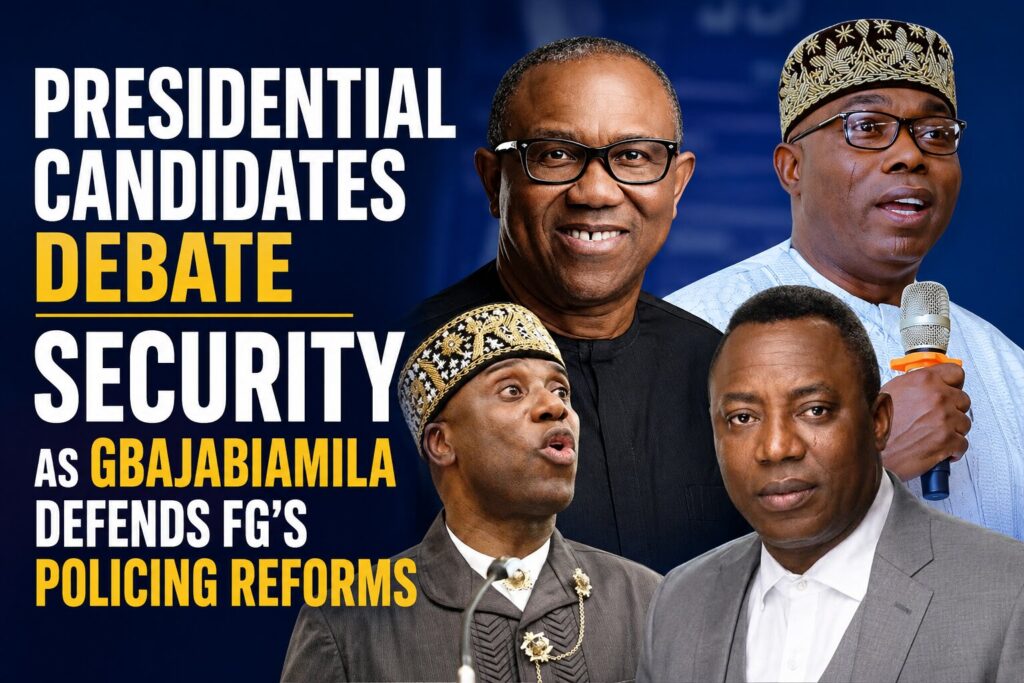
Security and the future of policing in Nigeria took centre stage at the 2026 Nigerian Bar Association Annual General Conference in Port Harcourt, where presidential candidates presented competing approaches to tackling insecurity while the Chief of Staff to the President, Femi Gbajabiamila, defended the Federal Government’s push for state police.
The presidential candidates’ panel featured Peter Obi, Rotimi Amaechi, Adewole Adebayo and Omoyele Sowore, with discussions spanning security, police reform, state policing, elections and fuel subsidy. The session also witnessed a heated exchange between Sowore and Amaechi after the former Rivers State governor rejected Sowore’s interpretation of remarks attributed to him.
On restructuring the police, most of the candidates backed the establishment of state police, although Adebayo advocated a three-tier policing structure covering the federal, state and local government levels.
The candidates, however, differed on the underlying causes of Nigeria’s security crisis and how they should be addressed. Sowore and Adebayo argued that a change in national leadership was necessary to confront insecurity, while Obi placed greater emphasis on tackling poverty as a critical component of any sustainable security strategy.
At a separate plenary session on democracy and governance, Sowore said persons found to have stolen public resources would face justice under his administration if elected, while former Cross River State Governor Donald Duke argued that getting Nigeria’s leadership right remained fundamental to solving the country’s wider problems.
Gbajabiamila, speaking in a keynote address titled “Policing in Transition,” defended the Tinubu administration’s move towards establishing state police, saying the President had chosen to confront a problem Nigeria had avoided for too long.
The Chief of Staff cautioned that decentralising policing without appropriate safeguards could create fresh problems, stressing that any new arrangement must guarantee equal protection to Nigerians irrespective of ethnicity, religion or other differences.
He said the proposed reform envisages a dual policing system intended to address shortcomings in the existing centralised structure, while insisting that the country must clearly identify the problems the reforms are designed to solve before implementing them.
The discussions at the NBA conference highlighted an emerging area of agreement across political divides that Nigeria’s policing architecture requires significant reform, even as political leaders remain divided over the precise structure and broader policies required to address insecurity.
You must be logged in to post a comment.