
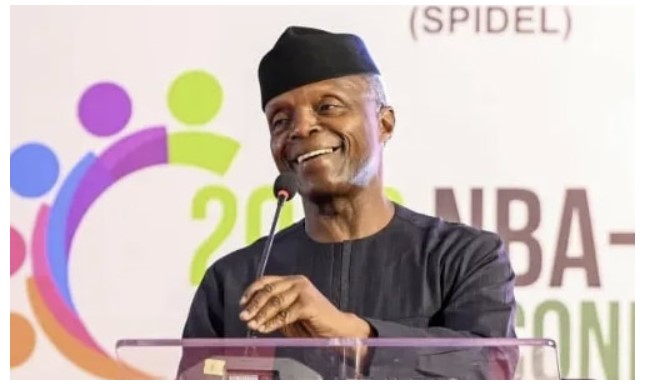
Former Vice President Yemi Osinbajo has challenged Nigerian lawyers to move beyond courtroom advocacy and electoral disputes to confront poverty, unemployment, corruption and delays in the administration of justice.
He said democracy should not be measured only by the conduct of elections or the existence of constitutional institutions, but by its ability to improve the welfare and living conditions of ordinary citizens.
Osinbajo spoke on Tuesday, November 10, while delivering the keynote address at the 2026 annual conference of the Nigerian Bar Association Section on Public Interest and Development Law (NBA-SPIDEL) in Umuahia, Abia State.
The conference was held under the theme, “In Public Interest: Advancing Justice, Democracy and Development.”
The former Vice President urged lawyers to see themselves as social engineers whose responsibilities extend beyond interpreting laws, preparing court processes and representing clients.
He said the legal profession must play a more active role in shaping public policy, promoting accountability, expanding economic opportunities and protecting vulnerable members of society.
According to him, democratic institutions must be assessed by the practical benefits they deliver, including access to jobs, food, healthcare, security and justice.
Osinbajo warned that persistent economic hardship and declining confidence in public institutions were weakening citizens’ faith in democratic governance.
Citing Afrobarometer findings, he said surveys across 39 African countries showed that only 46 per cent of respondents trusted their presidents, while 37 per cent expressed confidence in their parliaments. The figures for the courts and police stood at 47 and 46 per cent respectively.
He also cited findings indicating that 76 per cent of respondents were dissatisfied with government efforts to create jobs, while 73 per cent gave negative assessments of efforts to improve the living standards of poor people.
He said the figures reflected the need for governments to translate democratic promises into tangible improvements in people’s lives.
Osinbajo, however, rejected military rule and authoritarianism as alternatives to democratic shortcomings, insisting that the answer lay in strengthening institutions, accountability and public service delivery.
He urged public interest lawyers to scrutinise government budgets and expenditure, challenge administrative failures and work with communities to improve essential services.
Osinbajo raises alarm over judicial delays
The former Vice President also expressed concern over prolonged litigation and unequal access to justice, warning that excessive delays undermine public confidence in the judiciary.
He recalled an account given by a Supreme Court Justice during proceedings in England, suggesting that a case could take about 30 years to progress from the High Court to the Supreme Court in Nigeria.
Osinbajo said such delays made it difficult for the justice system to protect rights, resolve disputes and support economic development.
He stressed that equal rights before the law did not necessarily guarantee equal access to justice, particularly for poor Nigerians who could not afford legal representation and other litigation expenses.
To address the problem, he highlighted justice reforms introduced in Lagos State between 1999 and 2007, when he served as Attorney-General and Commissioner for Justice under the administration of then Governor Bola Tinubu.
He recalled the establishment of the Directorate for Citizens’ Rights, the Office of the Public Defender and Citizens’ Mediation Centres as measures aimed at making justice more accessible.
According to him, the mediation centres resolved more than 8,000 disputes in their first year, compared with fewer than 2,000 cases handled by Magistrates’ Courts during the same period. He added that the centres now resolve about 20,000 disputes annually.
He said such initiatives demonstrated the importance of providing affordable alternatives to prolonged and expensive court proceedings.
AI poses fresh challenge to legal profession
Osinbajo also warned that artificial intelligence could significantly disrupt the legal profession by automating tasks traditionally performed by lawyers.
He identified legal research, document analysis, drafting of court processes and preparation of legal opinions among the activities increasingly being handled by AI systems.
He said lawyers who failed to adapt to technological changes risked losing their relevance, urging practitioners to develop skills in negotiation, conflict resolution, technology and institutional analysis.
The former Vice President called on law faculties, the Nigerian Law School, the NBA and law firms to review legal education and professional training to prepare young lawyers for the changing demands of the profession.
He urged lawyers to learn how to verify AI-generated materials and remain professionally accountable for advice given to clients.
He also advocated protections for workers whose jobs could be displaced by technological developments, including advance notice of redundancies, consultation, retraining and redeployment opportunities.
Osinbajo further raised concerns about the impact of digital platforms on children, urging lawyers to pay greater attention to technology regulation and safeguards against exploitative digital practices.
He said NBA-SPIDEL should take a leading role in developing legal and policy responses to inequality, technological disruption and institutional failures.
The former Vice President concluded that the ultimate test of democracy and justice was whether they improved the lives of ordinary people.
He urged Nigerian lawyers to combine public interest advocacy with institutional reforms and practical engagement to ensure that democratic governance delivers justice, development and decent living conditions for citizens.
You must be logged in to post a comment.