
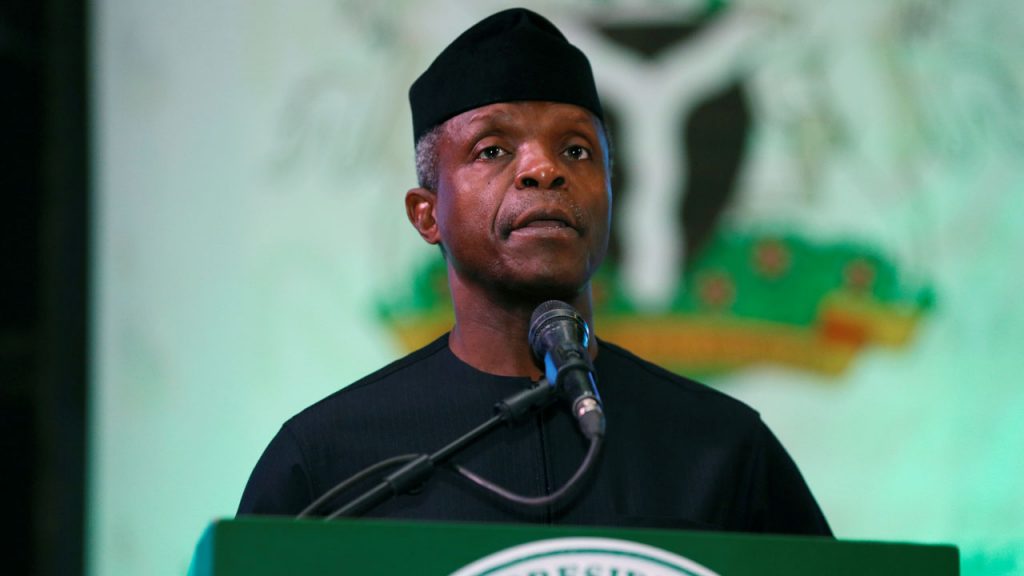
Former Vice-President Yemi Osinbajo has urged African countries to strengthen their local arbitration institutions and reduce dependence on foreign jurisdictions for the resolution of commercial disputes.
Osinbajo made the call at the 2026 Annual Conference of the Nigerian Institute of Chartered Arbitrators (NICArb) in Lagos, themed, “Reimagining Arbitration and ADR in Africa: Innovation, Integrity, and Commercial Justice in a Changing World.”
Delivering his keynote address through former Lagos State Attorney-General and his former Chief of Staff, Ade Ipaye, Osinbajo said African countries had historically relied on foreign jurisdictions to resolve major commercial disputes, particularly those involving oil and gas, mining, infrastructure and telecommunications.
He noted that disputes involving African parties were frequently taken to London, Paris, Geneva, Washington and Stockholm, allowing foreign institutions to shape arbitration jurisprudence.
According to him, Africans had largely remained consumers of a justice system designed for other people.
Osinbajo, however, acknowledged improvements in the continent’s arbitration landscape, citing Nigeria’s Arbitration and Mediation Act 2023, which introduced provisions on third-party funding, emergency arbitrators, consolidation of proceedings and mediation.
He identified Lagos, Kigali, Cairo, Mauritius, Nairobi and Johannesburg as emerging arbitration centres, urging African countries to prepare for disputes arising from artificial intelligence, digital commerce, the African Continental Free Trade Area and energy transition.
The former Vice-President identified innovation, integrity and commercial justice as critical pillars for strengthening arbitration and alternative dispute resolution across the continent.
He said dispute resolution should be treated as essential economic infrastructure because investors consider the time and cost of enforcing contracts when deciding where to invest.
Osinbajo advocated the wider deployment of technology, including virtual hearings, electronic documents, real-time transcription and remote examination of witnesses, to reduce the cost and duration of arbitration proceedings.
He also called for responsible adoption of artificial intelligence in arbitration, saying the technology could assist with document reviews, evidence summaries, case law analysis and preparation of procedural orders.
He, however, warned against allowing AI to replace the independent judgment of arbitrators.
On integrity, Osinbajo cited Nigeria’s $11 billion arbitration dispute with Process and Industrial Developments (P&ID), recalling that a London commercial court set aside the award against Nigeria in October 2023 after finding that it had been obtained through fraud, including bribery and improper use of privileged government legal documents.
He called for stricter disclosure requirements concerning arbitrators’ relationships, repeat appointments and potential conflicts of interest, including those involving third-party funders.
The former Vice-President also urged African courts to respect party autonomy, avoid unnecessary interference in arbitration and promptly enforce awards, while intervening where there was evidence of fraud or corruption.
On commercial justice, he said arbitration should be affordable and accessible to small and medium-sized businesses rather than being available mainly to large corporations and governments.
He added that the success of the African Continental Free Trade Area would partly depend on reliable mechanisms for resolving cross-border commercial disputes.
Osinbajo advocated affordable fees, faster procedures, effective enforcement mechanisms and wider adoption of the Singapore Convention on Mediation.
He urged African governments and arbitral institutions to invest in technology, strengthen ethical standards, improve cooperation between courts and arbitration institutions, and develop younger practitioners.
Addressing young lawyers, he encouraged them to take advantage of opportunities in arbitration rather than wait for senior practitioners to retire.
Also speaking at the conference, Lagos State Governor Babajide Sanwo-Olu reaffirmed his administration’s commitment to institutions that promote commercial justice and investor confidence.
Represented by the Attorney-General and Commissioner for Justice, Lawal Pedro, SAN, the governor said credible dispute resolution mechanisms were necessary for businesses to operate with confidence.
He cited the Lagos State Multi-Door Courthouse, Citizens’ Mediation Bureau and Lagos Court of Arbitration as institutions contributing to the state’s commercial dispute resolution framework.
President of the Nigerian Bar Association, Oyinkansola Badejo-Okusanya, also urged the Federal Government and public institutions to give Nigerian arbitrators more opportunities to handle commercial disputes instead of relying on foreign practitioners.
She said Nigeria had the expertise and institutions to compete internationally and should demonstrate greater confidence in local professionals.
NICArb President, Omoruyi Omonuwa, SAN, urged African countries to move beyond being users of international arbitration and become trusted destinations for resolving commercial disputes.
He said growing trade under AfCFTA, cross-border investments, digital commerce and energy transition had increased the need for affordable and impartial dispute resolution mechanisms.
Chairman of the conference planning committee, Oladipo Akinosun, SAN, warned that arbitration must not become another source of delay and excessive costs for businesses.
He called for effective case management, proportionate proceedings, appropriate time limits and stronger collaboration between arbitral institutions and the judiciary.
President of the International Council for Commercial Arbitration, Audley Sheppard, also disclosed plans to extend the council’s New York Convention roadshow programme to Nigeria to strengthen judicial capacity and promote enforcement of arbitral awards.
You must be logged in to post a comment.