
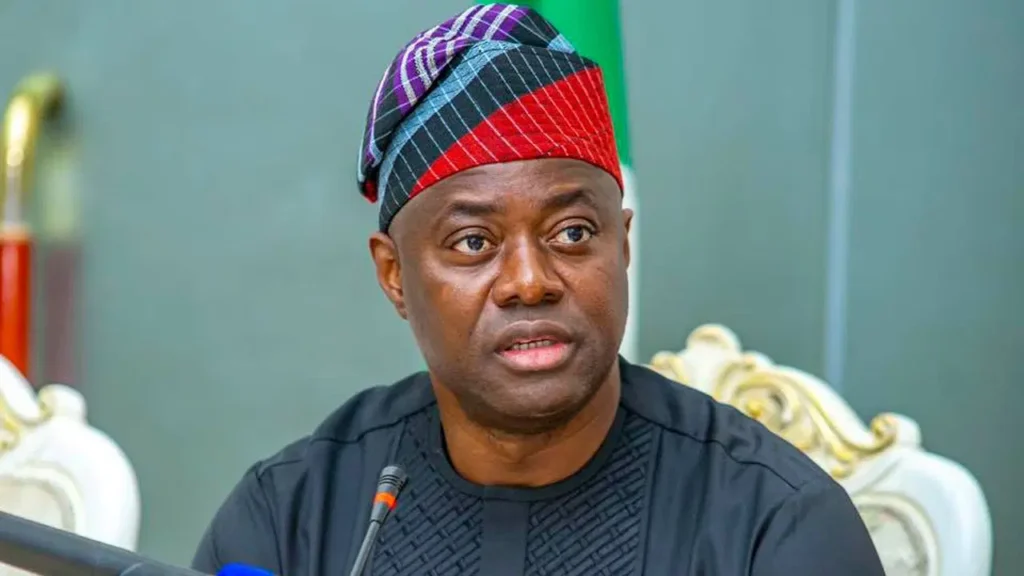
Oyo State Governor, Seyi Makinde, has charged journalists to uphold truth, fairness and professional ethics in their reportage as Nigeria prepares for the 2027 general elections.
Makinde gave the charge on Saturday in Ibadan at the grand finale of the 60th anniversary celebration and 2026 Press Week of the Nigeria Union of Journalists (NUJ), Oyo State Council.
The governor, represented by his Special Adviser on Media, Dr Sulaimon Olanrewaju, congratulated the union on attaining 60 years, describing the milestone as a testament to its contributions to democratic governance, public enlightenment and nation-building.
He urged media practitioners to remain impartial, give all stakeholders a fair hearing and verify information before publication, warning against misinformation, disinformation and political manipulation.
Makinde said the media’s loyalty must remain with truth and the public interest, rather than any political party, candidate or individual.
“Elections come and go. Politicians come and go. Governments come and go. But institutions endure. The credibility of the media must outlive every political contest,” he said.
The governor advised journalists to inform rather than inflame passions, educate rather than manipulate, and promote understanding instead of division.
He described professional journalism as indispensable to democracy, noting that citizens needed access to credible and balanced information to make informed decisions.
Makinde also paid tribute to the union’s founding members, past and present leaders, and journalists who had made sacrifices in defence of press freedom and the public’s right to information.
Makinde reaffirms commitment to media
The governor said his administration welcomed both commendations and criticism, noting that constructive scrutiny strengthened governance and accountability.
He cited the 2025 Democracy Performance Index, released by the Kimpact Development Initiative and published by StatiSense, which ranked Oyo State as Nigeria’s most democratic state.
Makinde attributed the recognition partly to the contributions of a vibrant and responsible media, and pledged to sustain a relationship with journalists based on openness, mutual respect and accountability.
He urged the NUJ to build on its six decades of achievements by strengthening ethical standards, professionalism and public trust as it enters its seventh decade.
Dare warns against AI-generated misinformation
At the anniversary lecture, Chief Sunday Dare, Special Adviser to President Bola Tinubu on Media and Public Communications, warned that artificial intelligence, deepfakes, voice cloning and digital manipulation posed growing challenges to journalism and democratic accountability.
Dare, a former Minister of Sports Development, was represented by former Director-General of the National Institute of Sports, Professor Olawale Moronkola.
He urged journalists to embrace technological innovation while retaining the human judgment, conscience and courage required to hold powerful individuals accountable.
Dare identified truthfulness, verification, independence, objectivity, balance, context, public interest and respect for human dignity as core principles of journalism.
He also cautioned against brown-envelope journalism, sensationalism, partisan reporting and the circulation of unverified information for social media attention.
He reminded journalists of their constitutional responsibility to hold government accountable, stressing that future generations would judge the profession by its commitment to truth, democracy and public interest.
NUJ seeks better welfare, protection for journalists
NUJ National President, Alhassan Yahya, whose address was presented by the union’s Vice-President for Zone B, Princess Ronke Afebioye-Samo, described the anniversary as six decades of struggle, sacrifice and service.
Yahya paid tribute to journalism pioneers, including Ernest Sesei Ikoli, Dr Nnamdi Azikiwe, Chief Obafemi Awolowo, Alhaji Lateef Jakande and Dele Giwa.
He identified fake news, misinformation, poor remuneration, insecurity, harassment and the growing influence of artificial intelligence among the challenges facing the profession.
The NUJ president called for improved welfare and protection of media practitioners, alongside continuous training, fact-checking, investigative reporting and digital innovation.
He said press freedom was a constitutional right, not a favour from government, and reaffirmed the union’s commitment to pursuing the Media Enhancement Bill and initiatives aimed at improving members’ welfare.
The anniversary brought together journalists and other stakeholders to reflect on the union’s history and the role of the media in strengthening democracy and accountability.
You must be logged in to post a comment.