
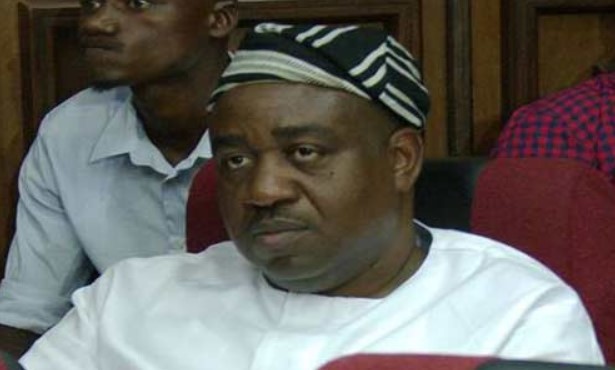
The Federal High Court in Abuja has reserved judgment in the alleged ₦3.1 billion money laundering case involving former Benue State Governor, Gabriel Suswam, and his former Commissioner for Finance, Omodachi Okolobia, bringing the 11-year-old trial to the final stage.
Justice Peter Lifu reserved judgment on Friday, November 27, 2026, after counsel to the defendants and the Economic and Financial Crimes Commission (EFCC) adopted their respective final written addresses.
The judge said the date for judgment would be communicated to the parties.
At the proceedings, lawyers to Suswam and Okolobia urged the court to discharge and acquit their clients, insisting that the prosecution failed to establish the allegations against them.
Suswam’s counsel, Chinelo Ogbozor, adopted the former governor’s final written address and reply on points of law, urging the court to acquit him on counts one to seven of the 11-count amended charge.
Similarly, counsel to Okolobia, Paul Erokoro, SAN, asked the court to discharge his client on counts eight to 11, arguing that the EFCC had failed to prove the alleged offences.
However, EFCC counsel, Rotimi Jacobs, SAN, maintained that the prosecution had presented sufficient evidence to establish the defendants’ involvement in the alleged diversion of public funds. He urged the court to convict them.
The case arose from allegations that about ₦3.1 billion realised from the sale of shares belonging to the Benue State Government through the Benue Investment and Property Company Limited (BIPC) was unlawfully diverted during Suswam’s second tenure as governor.
The EFCC alleged that the shares were sold through Elixir Securities Limited and Elixir Investment Partners Limited, while part of the proceeds was diverted between August and October 2014. The commission further claimed that the money was converted into foreign currency and delivered to Suswam.
One of the prosecution witnesses, Abubakar Umar, a bureau de change operator, testified that he converted the funds into approximately $15.8 million and handed the dollars to the former governor.
His testimony, however, became contentious after he changed his account in January 2018 concerning where the money was allegedly delivered. He also claimed that people close to Suswam had pressured him to alter his earlier statement.
The EFCC also accused Okolobia of carrying out financial transactions totalling ₦578 million in four instalments between December 2014 and January 2015, allegedly in breach of statutory cash transaction limits.
Both defendants denied the allegations and pleaded not guilty.
The EFCC first arraigned them in November 2015. The charges were later amended to 11 counts, while the case passed through three judges before it was reassigned to Justice Lifu in 2023. They were re-arraigned before him in March 2024.
During the trial, the prosecution called nine witnesses and tendered documentary evidence. The witnesses included EFCC investigators, a former managing director of BIPC and a bank compliance officer who testified about transactions involving Suswam’s naira and dollar accounts.
After the prosecution closed its case, the defendants filed no-case submissions, arguing that the evidence was insufficient to require them to enter a defence. Justice Lifu dismissed the applications in July 2025 and directed them to open their defence.
Suswam subsequently testified as the sole defence witness, while Okolobia did not testify or call any witness. The defence concluded its case in November 2025, after which the court directed the parties to file and exchange final written addresses.
The adoption of the addresses was delayed several times, including adjournments in May, July, September and October 2026.
With the final submissions now completed, the court is expected to determine whether the EFCC has proved the allegations against the defendants beyond reasonable doubt.
Until judgment is delivered, the allegations remain unproven, and both Suswam and Okolobia retain their pleas of innocence.
You must be logged in to post a comment.