
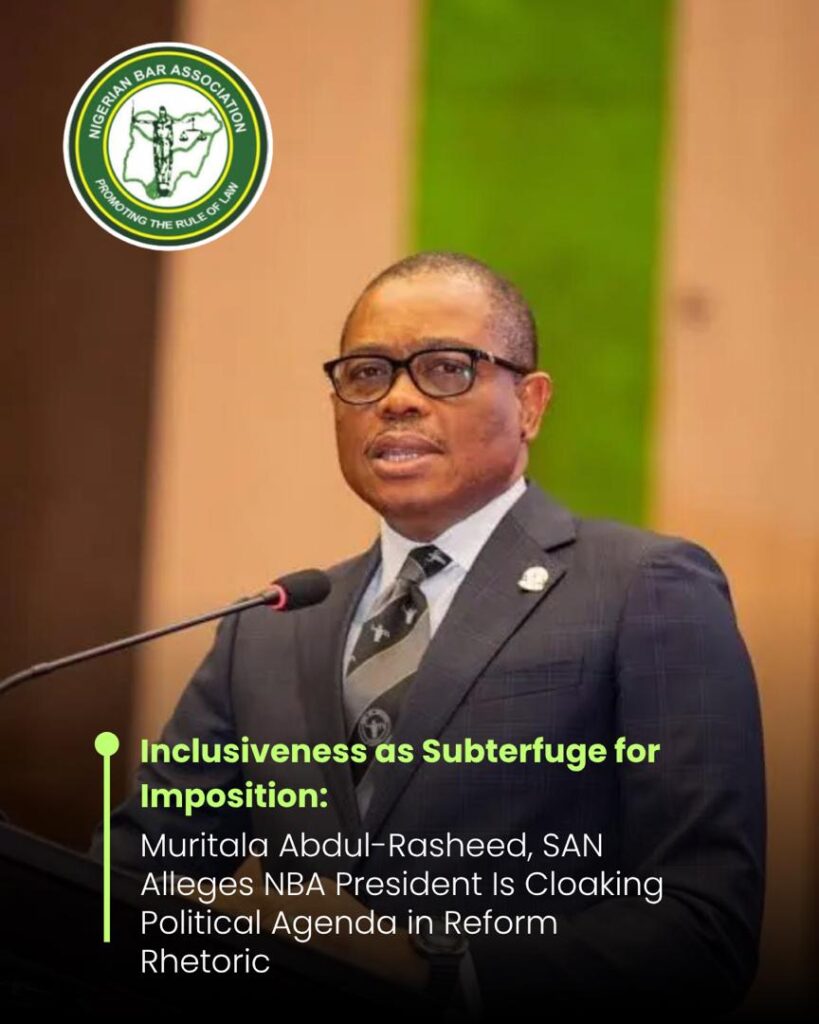
Muritala Abdul-Rasheed SAN, has raised fresh concerns over alleged partisanship within the Nigerian Bar Association, accusing its President, Afam Osigwe, of using the rhetoric of inclusiveness to subtly influence the outcome of the association’s forthcoming elections. In a strongly worded commentary following a recent advocacy meeting in Abuja, Abdul-Rasheed argued that the President’s public endorsement of a female candidate, Oyinkansola Badejo-Okusanya, under the banner of promoting women’s participation, represents a calculated political move that undermines established zoning arrangements and threatens the neutrality expected of the office, while also casting doubt on the credibility of the NBA’s electoral process.
When principle becomes pretext: the NBA President’s partisan use of ‘Inclusiveness’
Muritala Abdul-Rasheed, SAN, Ph.D
The office of the President of the Nigerian Bar Association (NBA) is one that carries not only administrative authority but also immense moral responsibility. It is an office expected to embody dignity, honour, neutrality, fairness, and fidelity to the collective will of the Bar. When that office is deployed as an instrument of subtle but aggressive political engineering, cloaked in the language of noble ideals, it raises profound concerns about institutional integrity.
The recent conduct of the NBA President, Mr. Afam Osigwe, SAN, at a strategic advocacy meeting on women inclusiveness held on April 13, 2026, at Abuja Continental Hotel, represents yet another troubling chapter in what has become a pattern of calculated and orchestrated partisanship.
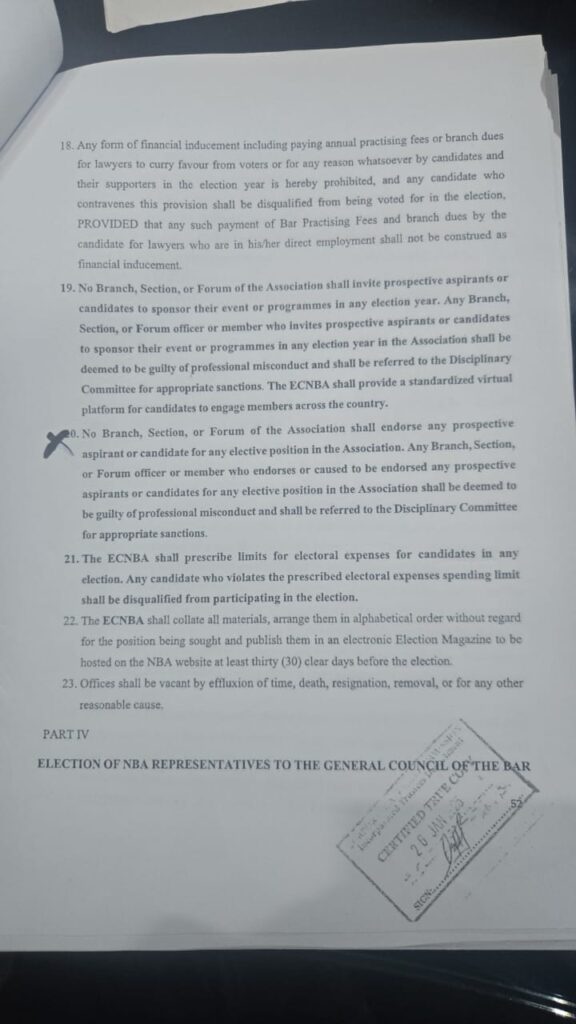
At the said event, organised by the NBA Section on Public Interest and Development Law (SPIDEL) in conjunction with other organisations, the President, under the guise of promoting inclusiveness, openly canvassed support for the emergence of a female President of the NBA in the forthcoming elections. While, on the surface, this may appear as a progressive and commendable position, a deeper interrogation reveals a far less altruistic motive. The intervention was neither neutral nor institutional, it was intentional, deliberate, political, targeted, and self-serving.
For any objective observer of recent developments within the Bar, it is evident that this sudden advocacy for gender inclusiveness is not borne out of conviction but convenience. It is a thinly veiled attempt to advance the candidature of a particular aspirant, Mrs. Oyinkansola Badejo-Okusanya, SAN, in direct opposition to the consensus candidate of the South-West Zone/Egbe Amofin, Aare Muyiwa Akinboro, SAN, whose emergence followed a rigorous, transparent, and widely accepted process within the South-West Zone (Egbe Amofin Oodua); or, put in another form to rubbish the micro-zoning/sub-zoning done by the Egbe Amofin in compliance with the NBA Constitution, whereat the Egbe micro-zoned/sub-zoned the production/presentation of candidate for the position of President this time around to the Oyo/Osun Zone for the purpose of justice, equity, fairness and inclusiveness.
This latest action must be situated within the broader context of the President’s earlier conduct, which has consistently betrayed a disposition towards partisanship. From his now infamous declaration that he could not remain neutral in the forthcoming elections, to the various controversies that have trailed his tenure, there has emerged a clear pattern: the steady erosion of the moral authority of the office he occupies.
What makes this development particularly troubling is the attempt to weaponise a universally accepted principle, gender inclusiveness, for partisan ends. Inclusiveness, in its true sense, is a value that must be consistently upheld across time and circumstance. It cannot be selectively invoked when it aligns with personal or political objectives, only to be discarded when it does not.
A brief excursion into recent history exposes the glaring inconsistencies in the President’s newfound advocacy. In 2014, when a highly qualified and widely respected female candidate, Mrs. Funke Adekoya, SAN, contested for the office of NBA President, the same Mr. Osigwe did not lend his voice or influence to the cause of gender inclusiveness. Instead, he supported a male candidate, Mr. Augustine Alegeh, SAN, who eventually emerged victorious. There was no clarion call then for the Bar to “give a woman a chance.”
Similarly, in 2020, when Mrs. Joyce Oduah contested for the position of General Secretary of the NBA, the President did not position himself as a champion of women’s participation in leadership. On the contrary, he openly aligned with her opponent. Again, the rhetoric of inclusiveness was conspicuously absent.
Perhaps the most telling example of this inconsistency occurred as recently as 2025 during the leadership process of the NBA Section on Public Interest and Development Law (SPIDEL) itself, the very platform from which he now preaches inclusiveness. At that time, a female candidate, Dr. Joy Agbi, was widely regarded as being on a clear path to victory in the contest for the chairmanship of SPIDEL.
Yet, rather than allow the democratic process to run its course, the President intervened in a manner that disrupted the process and ultimately resulted in the imposition of a caretaker committee composed of individuals of his choosing. That intervention effectively truncated what could have been a landmark moment for female leadership within the NBA.
It is, therefore, nothing short of a deplorable irony that the same platform, whose democratic process he undermined to the detriment of a female aspirant, is now being used as a decoy to advocate for women’s inclusiveness. Such contradiction does not inspire confidence; rather, it underscores a troubling pattern of opportunism.
The unavoidable conclusion from these facts is that the President’s current posture is not driven by a principled commitment to gender equity but by a calculated desire to influence the outcome of the forthcoming NBA elections. It is a classic case of advocacy being reduced to subterfuge, where noble ideals are appropriated as tools of political manipulation.
This conduct is particularly egregious when viewed against the backdrop of the established zoning and micro-zoning arrangements within the NBA. The South-West Zone, under the aegis of Egbe Amofin Oodua, had undertaken a painstaking process to identify and present a consensus candidate in line with the principles of fairness, inclusiveness, and internal democracy.
That process culminated in the emergence of Aare Muyiwa Akinboro, SAN, a candidate who not only satisfies the criteria set by the screening committee but also embodies the collective will of the region whose turn it is to produce the next President of the NBA. Furthermore, any rational or honest observer of the meetings, decisions, and reports emanating from the South‑West/Egbe Amofin will appreciate the fact that, in line with the NBA Constitution, the Egbe has zoned or sub‑zoned the presentation of its candidate for the office of President to the Oyo/Osun Zone, outside the Lagos/Ogun Zone, from where the President’s favoured candidate, Mrs. Oyinkansola Badejo‑Okusanya, SAN, hails. This inevitably leads to a more pertinent, realistic, and honest question, to wit: are there no qualified women lawyers from the Oyo/Osun Zone? Still, in order to bring to the fore the antics of the NBA President, other paramount, crucial, and soul‑searching questions arise: these include: when did the NBA President suddenly awaken to the imperative of foisting a woman President of his choice on the Nigerian Bar Association, the largest congregation of lawyers in Africa? Was this a result of a sudden dream? Why did he fail to advance this prognosis in 2024, when it was the turn of the South‑East Zone, his own zone of origin, to produce the President of the NBA? Why did he instead contest, rather than stepping aside or projecting the cause or candidature of one of the many highly erudite and professionally accomplished women within the South‑East, including Professors, Learned Senior Advocates, and recognised Bar Leaders, etc. It is also very worrisome and concerning that the NBA President who is aware of pending causes against him in respect of the way and manner he is trying to manipulate the forthcoming NBA elections, as well as, injunctive orders against him, is the one, telling the entire world, by his action and utterances today, that he does not care a damn about the rule of law or accord any respect to court processes.
For the sitting President of the Association to, in effect, undermine this process by openly canvassing support for an alternative agenda is to strike at the very heart of the institutional order of the Bar. It sends a dangerous message that established processes and collective decisions can be overridden by the personal preferences of those in positions of authority.
More fundamentally, it raises serious questions about the President’s capacity to provide the neutral and impartial leadership required to oversee a credible electoral process. An election cannot be said to be free and fair when the incumbent President has so openly aligned himself with a particular outcome.
The NBA, as the largest body of lawyers in Africa, occupies a unique position as a moral compass in the nation’s democratic journey. It routinely calls on political actors to uphold the principles of fairness, transparency, and the rule of law. It cannot, therefore, afford to fall short of these standards within its own internal processes. To do so would not only diminish its moral standing but also erode public confidence in its ability to speak truth to power.
In the final analysis, the issue is not whether the NBA should, at some point, produce a female President. That is a legitimate aspiration and one that deserves serious consideration within the framework of fairness and due process.
The issue, rather, is the propriety of a sitting President using the weight of his office to subtly but unmistakably influence the outcome of an election under the guise of promoting inclusiveness.
Leadership demands consistency. It demands integrity. It demands that those who occupy positions of trust act in ways that inspire confidence rather than suspicion. Unfortunately, the recent actions of the NBA President fall far short of these expectations.
The Bar must, therefore, rise in defence of its institutional integrity. It must reject attempts to manipulate its processes under whatever guise they may come. And it must insist that those entrusted with leadership conduct themselves in a manner that reflects the highest ideals of the profession.
Anything less would not only betray the trust of its members but also compromise the legacy of an institution that has, for decades, stood as a beacon of justice, fairness, and the rule of law.
Muritala Abdul-Rasheed, SAN, Ph.D aka Murray, is a former Publicity Secretary, Nigerian Bar Association (NBA)
You must be logged in to post a comment.