
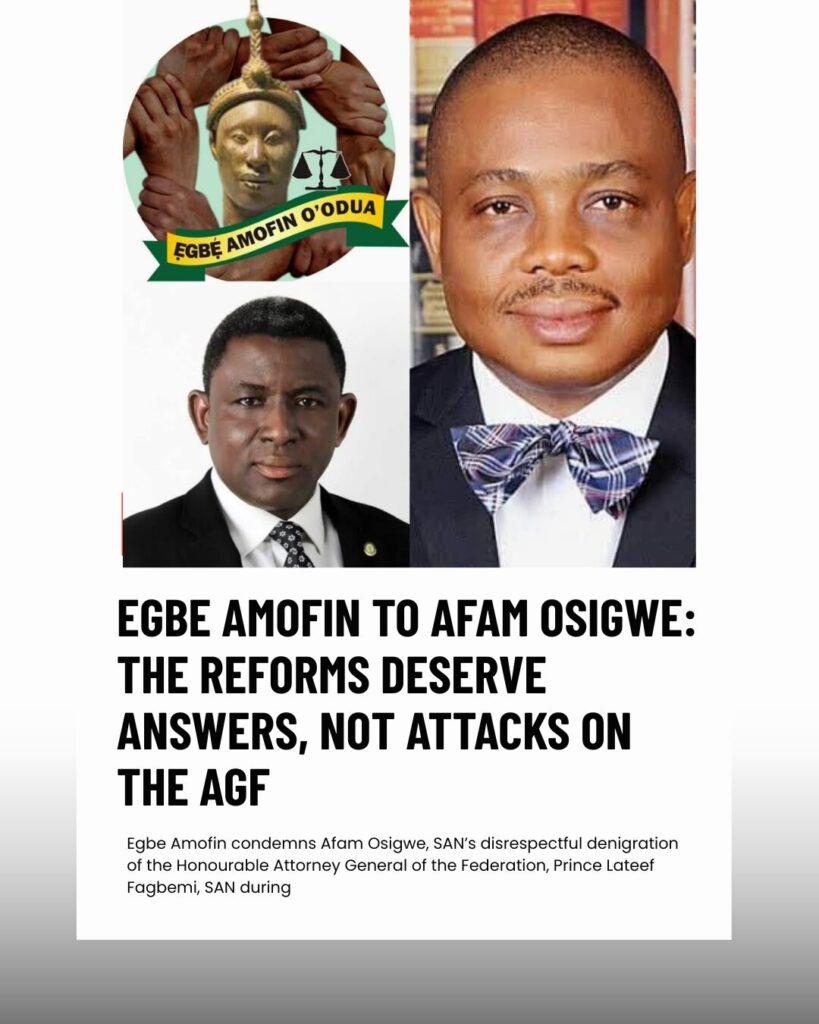
Egbe Amofin O’odua has joined issues with Nigerian Bar Association (NBA) President Mazi Afam Osigwe (SAN) over the Attorney-General of the Federation’s recent directions on the 2026 NBA elections, insisting that the intervention was driven by the need to safeguard the integrity of the Association’s electoral process.
In a statement titled “The Question Afam Osigwe, SAN, President Nigerian Bar Association Must Answer: Why is He Uncomfortable with a Free, Fair, Transparent and Credible Election?”, the forum also criticised the Eastern Bar Forum (EBF) and the Mid-West Bar Forum (MBF) for opposing the AGF’s recent directions on the 2026 NBA elections, insisting that none of the substantive recommendations of the committee set up by the AGF had been faulted.
The statement followed reactions trailing the AGF’s acceptance of recommendations submitted by a three-member committee headed by former NBA President, Chief Wole Olanipekun (SAN), constituted to examine disputes arising from the forthcoming NBA national elections.
Egbe Amofin described the criticism directed at the AGF and the committee as misplaced, arguing that the debate should focus on strengthening the integrity of NBA elections rather than attacking those championing reforms.
The forum maintained that electoral controversies within the NBA did not begin with the current administration, recalling criticisms that greeted the 2018 NBA presidential election by respected senior lawyers, including Chief Arthur Obi-Okafor (SAN), Professor Ernest Ojukwu (SAN) and Professor Chidi Odinkalu, who publicly questioned the credibility of that exercise. It argued that those concerns demonstrated that reforms had become inevitable.
Defending the process that produced the committee, the forum said the panel emerged from a meeting convened by the AGF with past NBA Presidents and stakeholders, stressing that Chief Olanipekun initially declined the assignment before accepting it at the insistence of participants at the meeting.
The group further alleged that although the NBA President indicated his willingness to engage the committee virtually, he failed to participate in the scheduled interaction despite receiving the meeting link and follow-up telephone calls from members of the committee. It noted that even a minority report submitted by committee member, Paul Usoro (SAN), expressed regret over the NBA President’s failure to honour the invitation.
On the directives issued by the Attorney-General, Egbe Amofin argued that the AGF, as the Chief Law Officer of the Federation, possesses both the constitutional and institutional responsibility to ensure compliance with extant laws affecting the legal profession. It particularly defended the requirement relating to the use of the National Identification Number (NIN), describing it as a lawful identity verification mechanism intended to curb impersonation, multiple registrations and other electoral abuses.
The forum acknowledged that the AGF did not adopt every recommendation made by the committee, particularly the proposal on sub-zoning, but noted that the Attorney-General accepted that such reforms should take effect from the next election cycle rather than the current one. According to the forum, this demonstrated that the process was objective and not designed to favour any particular group.
Egbe Amofin also defended key recommendations of the committee, including the compilation of a fresh voters’ register from verified practising fee records, stronger voter authentication procedures and reforms to the NBA’s electoral framework, describing them as practical measures capable of enhancing transparency and public confidence in future elections.
The forum accused critics of deliberately diverting attention from those recommendations by introducing issues such as “universal suffrage,” insisting that neither the committee’s report nor the AGF’s directions proposed such a model.
On the contentious issue of zoning and the 2026 presidential election, Egbe Amofin rejected suggestions that its position was motivated by opposition to the emergence of a female NBA President. Rather, it maintained that its objection was to what it described as attempts to impose candidates on the South-West outside agreed zoning arrangements. The forum pointed to the contributions of several distinguished female lawyers from the South-West and insisted that its position was rooted in due process rather than gender considerations.
The organisation also defended its decision to institute legal proceedings in Ibadan over the NBA election dispute, insisting that litigation became necessary after repeated efforts to resolve the issues internally allegedly yielded no response. It argued that recourse to the courts remains a constitutionally guaranteed right and should not be portrayed as an attack on the Association.
Turning to the Eastern Bar Forum and the Mid-West Bar Forum, Egbe Amofin urged both groups to direct their attention to the broader institutional challenges confronting the NBA rather than what it described as sustained attacks on the Attorney-General and senior leaders of the South-West. It maintained that inter-regional disagreements should not be allowed to further polarise the legal profession.
Reaffirming its commitment to the unity of the Association and the integrity of its electoral process, the forum declared: “It is now time for the physician in the NBA to heal itself; for the intruder in the NBA to remove the log in its eyes, rather than searching for the speck in another man’s eyes.” It added that “those who want to pull the NBA down know themselves,” while urging all stakeholders to embrace reforms capable of guaranteeing credible, transparent and legally compliant elections.
You must be logged in to post a comment.