
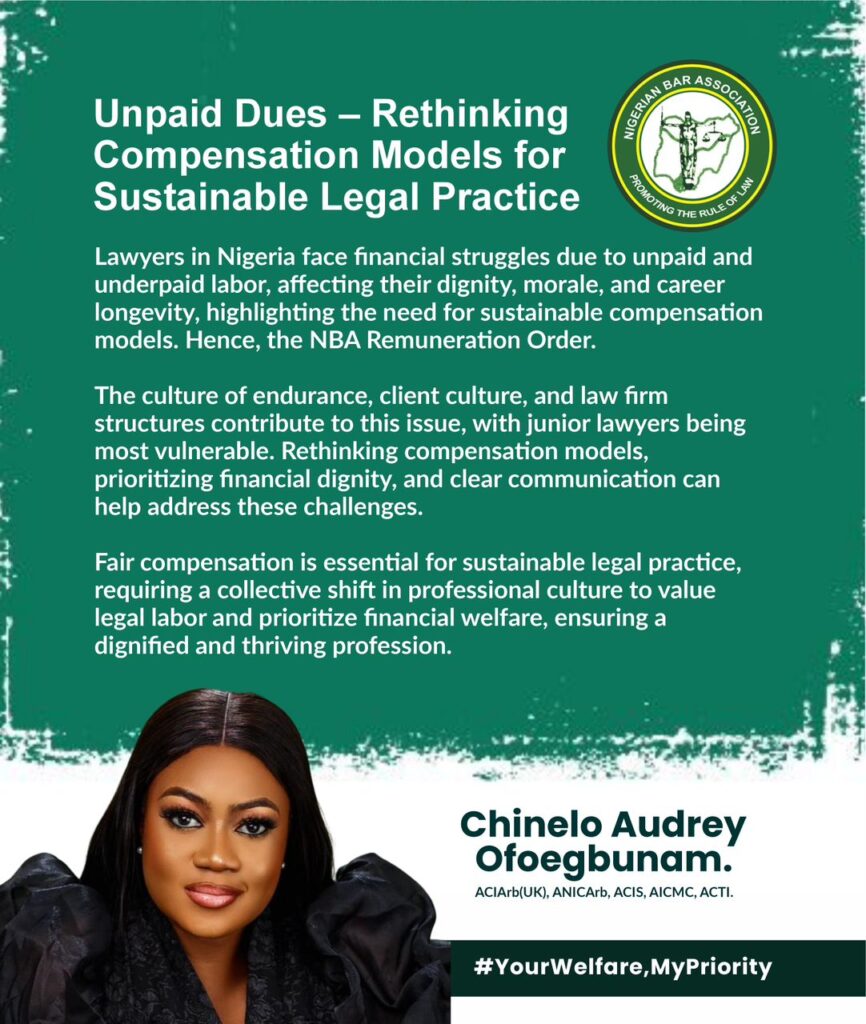
Unpaid Dues – Rethinking Compensation Models for Sustainable Legal Practice
By Chinelo Audrey Ofoegbunam
Introduction
Legal practice is built on precision, advocacy, and service, yet behind the polished submissions and courtroom rituals lies a quieter struggle that many lawyers endure without complaint: unpaid and underpaid labour. From delayed salaries and unpaid retainers to professional services rendered on trust that never materializes into payment, financial uncertainty has become an uncomfortable norm for many practitioners.
This strain is not merely financial; it is deeply personal. Inconsistent compensation erodes dignity, fuels anxiety, and forces lawyers to balance professional commitment against personal survival. When lawyers cannot rely on predictable income, the consequences ripple into every aspect of their lives—from housing and health to mental wellbeing and career longevity. Sustainable legal practice, therefore, cannot exist without sustainable compensation. Fair pay is not a privilege; it is a welfare imperative.
1. The Culture of Endurance – Normalizing Unpaid Effort
Over time, the legal profession has cultivated a culture that rewards endurance over equity. Young lawyers are often encouraged to “be patient,” “gain experience,” or “wait their turn,” even when compensation is delayed, inconsistent, or absent. Unpaid effort is reframed as investment, and financial struggle is presented as a rite of passage rather than a systemic issue.
This normalization of unpaid work is reinforced by hierarchy and tradition. Many lawyers fear that questioning compensation will be interpreted as ingratitude or lack of commitment. As a result, they absorb financial hardship silently, convincing themselves that persistence will eventually lead to reward. Yet prolonged under-compensation does more than strain finances—it erodes morale, diminishes self-worth, and creates quiet resentment within the profession.
Endurance may build character, but it should not come at the cost of dignity. When unpaid labour becomes standard, it devalues legal work and undermines the very professionalism the field seeks to uphold. A culture that equates suffering with dedication risks losing talented practitioners who simply cannot afford to stay.
2. Understanding the True Cost of Legal Labour
Legal work extends far beyond time spent in court or drafting documents. Each matter requires intellectual preparation, emotional investment, logistical coordination, and personal sacrifice. Lawyers absorb hidden costs daily—transportation to courts, data and research expenses, communication costs, and the opportunity cost of time that could have been used for paid work or rest.
When compensation fails to reflect these realities, legal labour is undervalued. Unpaid consultations, last-minute client demands, and extended working hours without corresponding remuneration quietly distort the worth of professional expertise. Over time, lawyers internalize this imbalance, often underpricing their services or tolerating delayed payments as inevitable.
Recognizing the true cost of legal labour is essential to rethinking compensation models. Fair pay acknowledges not only output but effort, expertise, and responsibility. When compensation reflects the full scope of legal work, it restores balance, reinforces professional value, and supports the wellbeing of those who sustain the justice system.
3. Junior Lawyers and the Vulnerability Gap
No group feels the weight of unpaid dues more acutely than junior lawyers. At the early stages of practice, enthusiasm often collides with economic reality. Freshly called lawyers enter the profession eager to learn, serve, and build competence, yet many quickly encounter unstable or inadequate compensation arrangements that leave them financially exposed.
This vulnerability is amplified by power imbalance. Junior lawyers depend on senior practitioners and law firm structures for training, exposure, and career progression. The fear of being labelled difficult, impatient, or ungrateful discourages open conversations about pay. As a result, many silently accept delayed salaries, unclear remuneration terms, or excessive workloads that are not matched by financial reward.
The long-term impact is profound. Financial insecurity affects confidence, limits access to further professional development, and increases emotional stress. Some talented young lawyers leave practice entirely, not because they lack passion or ability, but because they cannot sustain themselves economically. When early-career lawyers are not adequately supported, the profession risks losing its future. Addressing compensation at this level is therefore not only an act of fairness but an investment in continuity and professional excellence.
4. Client Culture and the Devaluation of Legal Services
Beyond internal professional structures, client attitudes significantly influence compensation challenges in legal practice. Many clients view legal services as transactional only when a case reaches court, overlooking the extensive advisory, preparatory, and strategic work that happens behind the scenes. Informal consultations, endless phone calls, and “quick questions” are often expected without payment, subtly diminishing the value of legal expertise.
This culture places lawyers in a difficult position. The desire to be helpful, maintain relationships, or secure future briefs often leads practitioners to provide unpaid services with the hope that compensation will follow. Unfortunately, such expectations frequently go unmet. Over time, this pattern reinforces the perception that legal advice is endlessly accessible and negotiable in value.
Changing this narrative requires deliberate professional boundaries and client education. When lawyers clearly communicate the scope and value of their work, clients are more likely to respect both the service and the professional providing it. Sustainable compensation depends not only on internal reform but also on reshaping public understanding of legal labour as skilled, time-intensive, and deserving of fair remuneration.
5. Law Firm Structures and Payment Priorities
Within many law firms, compensation challenges are not solely the result of difficult clients or market conditions; they are often rooted in internal structures and financial priorities. In some workplaces, salary arrangements are informal, undocumented, or inconsistently applied. Lawyers may be uncertain about when they will be paid, how performance is measured, or what criteria determine increments and bonuses. This lack of transparency creates anxiety and erodes trust within professional relationships.
Delayed salaries and unclear payment arrangements have tangible consequences. Lawyers who cannot predict their income struggle to plan their lives, meet personal obligations, or invest in their own professional growth. Financial instability seeps into work quality, concentration, and morale. A practitioner preoccupied with unpaid wages may find it difficult to maintain the ethical clarity and emotional composure required for effective advocacy.
Predictable income is not merely a financial convenience—it is a foundation for ethical and sustainable practice. When lawyers are assured of regular, transparent compensation, they are better positioned to resist undue pressure, maintain professional boundaries, and focus on delivering quality service. Firms that prioritize clear payment structures cultivate loyalty, reduce burnout, and foster a culture of mutual respect. In such environments, legal practice becomes a profession sustained by dignity rather than endurance.
6. Rethinking Compensation Models for Sustainability
Sustainable legal practice requires a willingness to move beyond traditional compensation models that no longer reflect the realities of modern legal work. While hourly billing has long been the default, it often fails to capture the true value of legal expertise or the intensity of professional responsibility. It can also reward time spent rather than outcomes achieved, inadvertently promoting inefficiency and fatigue.
Alternative models offer pathways to greater stability and fairness. Retainer arrangements provide predictable income while allowing lawyers to plan their workload and resources more effectively. Milestone-based fees align payment with progress, ensuring that lawyers are compensated at key stages of a matter rather than waiting indefinitely for resolution. Value-based pricing recognizes expertise, complexity, and risk, rewarding skill and judgment rather than mere time investment.
At the heart of these models is a simple principle: compensation should reflect effort, expertise, and responsibility. Legal work involves strategic thinking, emotional labour, and significant risk exposure. When compensation systems acknowledge these realities, they support both professional welfare and service quality. Rethinking how lawyers are paid is not about commodifying justice—it is about sustaining those entrusted with delivering it.
7. Financial Dignity as Professional Welfare
Financial stability is inseparable from professional wellbeing. When lawyers are consistently underpaid or uncertain about compensation, the impact goes beyond economic discomfort—it affects self-worth, confidence, and emotional health. Financial anxiety can quietly undermine focus, creativity, and ethical decision-making, turning what should be a vocation of service into a daily struggle for survival.
Dignified compensation affirms the value of legal work. It enables lawyers to meet personal responsibilities, plan for the future, and engage their practice with clarity rather than desperation. When financial welfare is protected, lawyers are less vulnerable to undue influence and better equipped to uphold professional standards. Sustainable compensation is therefore not just about money; it is about preserving the moral and psychological foundations of legal practice.
8. Communication, Contracts, and Clarity
Many compensation disputes arise not from bad faith but from unclear expectations. Vague fee arrangements, informal agreements, and unspoken assumptions create fertile ground for delay and disappointment. Clear communication is one of the most powerful tools lawyers possess to protect their professional value.
Written fee agreements, defined scopes of work, and transparent billing timelines set boundaries that benefit both lawyers and clients. These practices foster trust, reduce conflict, and normalize respect for professional time. Clarity also empowers lawyers to say no to unpaid labour without guilt, reinforcing the principle that legal expertise is neither casual nor expendable.
By prioritizing communication and documentation, lawyers move from reactive to proactive compensation management—protecting their welfare while maintaining professionalism.
9. Building a Culture of Respect for Legal Labour
Compensation reform cannot rest on individual effort alone; it requires a collective shift in professional culture. When lawyers support one another in setting fair boundaries and discussing compensation openly, they weaken the stigma surrounding financial advocacy. Silence benefits exploitation; dialogue fosters fairness.
Respect for legal labour begins with internal acknowledgment of its value. Peer conversations, shared standards, and mutual accountability contribute to a profession that sustains its practitioners rather than exhausting them. When lawyers collectively affirm that their work deserves fair and timely compensation, they reinforce the dignity of the profession itself.
Conclusion
Unpaid dues are not merely administrative oversights—they are signals of deeper structural imbalance. A legal profession that cannot reliably sustain its members risks losing both talent and integrity. Rethinking compensation models is therefore an urgent act of professional self-preservation.
Sustainable legal practice rests on fairness, transparency, and respect for labour. When lawyers are compensated predictably and fairly, they are free to focus on service, ethics, and excellence. By valuing the people behind the practice, the profession strengthens its future—ensuring that justice is delivered not by endurance alone, but by dignity and care.
Connect with me on Social Media:
X: CIAO Legal
LinkedIn: Chinelo Audrey Ofoegbunam
Instagram: CIAO Legal
Facebook: Chinelo Ofoegbunam