
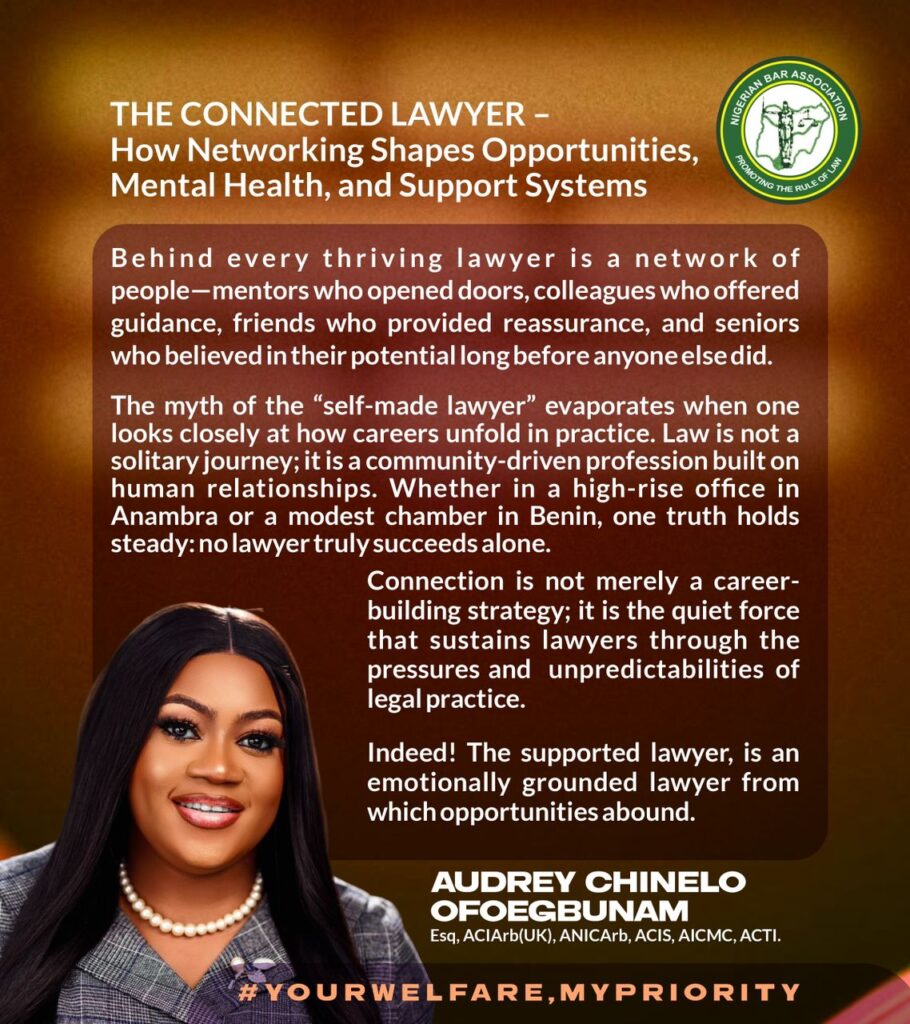
THE CONNECTED LAWYER – How Networking Shapes Opportunities, Mental Health, and Support Systems
By Chinelo Audrey Ofoegbunam
Introduction
Behind every thriving lawyer is a network of people—mentors who opened doors, colleagues who offered guidance, friends who provided reassurance, and seniors who believed in their potential long before anyone else did. The myth of the “self-made lawyer” evaporates when one looks closely at how careers unfold in practice. Law is not a solitary journey; it is a community-driven profession built on human relationships. Whether in a high-rise office in Lagos or a modest chambers in Uyo, one truth holds steady: no lawyer truly succeeds alone. Connection is not merely a career-building strategy; it is the quiet force that sustains lawyers through the pressures and unpredictabilities of legal practice.
The Power of Belonging – How Connection Strengthens Emotional Well-being
Many lawyers underestimate the psychological strength that comes from a sense of belonging. Legal practice demands intellectual sharpness, emotional resilience, and continuous composure, even on the most challenging days. The weight of clients’ expectations, the stress of adversarial proceedings, and the pressure to perform flawlessly can create an emotional storm beneath the surface. Yet, when a lawyer is surrounded by supportive colleagues, relatable peers, and accessible mentors, the storm subsides. Connection becomes a protective shield, easing anxiety and providing a space where vulnerability is allowed. Belonging acts as an emotional anchor—reminding lawyers that their struggles are not signs of weakness but universal experiences shared across the profession.
When Relationships Become Opportunity Pipelines
In the world of legal practice, opportunities rarely come from isolation. They flow through the channels of trust built over time—trust formed in classrooms, chambers, conferences, and court corridors. A senior recalls the diligence of a young lawyer and recommends them for a major brief. A classmate refers a high-value client. A colleague invites another to join a significant transaction or collaborative project. These moments reshape careers long before any job advertisement or public notice. Networking, in its truest form, is not about accumulating contacts—it is about building meaningful, professional relationships that evolve into pipelines of opportunity. Within Nigeria’s competitive legal landscape, connection often unlocks doors that skill alone cannot.
Emotional Safety in a Demanding Profession
Legal practice tests emotional strength in ways the public rarely sees. Tough rulings, difficult clients, strained deadlines, and the constant demand for confidence can erode even the strongest spirit. Lawyers are expected to maintain composure, hide fatigue, and solve complex problems without showing strain. Over time, this emotional masking becomes draining. But a supportive network changes the equation. A colleague’s encouragement after a taxing hearing, a mentor’s reassurance following a setback, or a friend’s candid conversation about their own struggles can provide immense relief. Emotional safety—born from genuine human connection—keeps lawyers grounded. It reminds them that they are not alone in their battles, and that even in a demanding profession, vulnerability is not a flaw but a shared human truth.
The Healing Power of Mentoring Circles and Learning Communities
One of the most transformative forms of connection in the legal profession is found in mentoring circles and learning communities—small, supportive groups where lawyers gather not merely to exchange knowledge, but to share humanity. For many early-career lawyers, these circles serve as a lifeline, offering reassurance in a profession that often feels overwhelming. A young practitioner may walk into a meeting feeling confused or inadequate, yet walk out with clarity simply by hearing others share similar struggles.
These communities create rare spaces in law where vulnerability is permitted without consequence. Lawyers can admit they don’t understand a concept, confess the fear of their first court appearance, or seek guidance on ethical dilemmas—free from judgment or ridicule. In these intimate settings, real growth happens not because the information is new, but because the environment is safe.
Mentors within these circles do far more than teach. They steady the emotional turbulence that comes with the profession. Their stories—of failures survived, mistakes forgiven, and careers rebuilt—offer younger lawyers a roadmap filled with compassion instead of perfection. In this way, mentors become emotional anchors, providing both guidance and grounding. Every profession needs teachers. The legal profession, however, needs healers—those who stabilize, encourage, and remind others that excellence is cultivated, not inherited.
The Social Architecture of Law Firms – How Internal Networks Shape Welfare
Every law firm, no matter how large or small, has an internal social structure—a subtle architecture of alliances, friendships, hierarchies, and working cultures. This internal ecosystem has more impact on a lawyer’s welfare than most people realize. In cohesive firms where teamwork is valued, information flows freely, ideas are welcomed, and colleagues support one another, lawyers tend to thrive. They find confidence in collaboration and comfort in camaraderie.
But the opposite environment—one marked by hostility, competition, or silent tension—can quietly erode a lawyer’s wellbeing. A firm where juniors fear asking questions, where colleagues work in silos, or where recognition is scarce becomes emotionally draining. Over time, even the most talented lawyers begin to doubt themselves, retreat emotionally, or lose motivation.
Healthy internal networks promote fairness, shared responsibility, and mutual respect. They encourage collaboration, reduce burnout, and inspire ethical decision-making. Lawyers feel less alone, more valued, and better equipped to manage professional pressure. A firm’s internal culture, therefore, is not just a management issue—it is a welfare issue. The underlying relationships within a firm can either strengthen a lawyer’s resilience or accelerate their exhaustion.
Digital Networking – Expanding Support Systems Beyond Geography
The digital age has reshaped the way lawyers connect, learn, and support one another. Virtual communities on platforms like WhatsApp, LinkedIn, and specialized legal forums have become powerful spaces where lawyers from different states—and even different countries—exchange ideas, troubleshoot problems, and share resources in real time. This digital shift has turned networking into an accessible, borderless tool.
For lawyers practicing in less populated regions or those in solo practice, digital connections offer something priceless: community. Through online networks, they can ask questions, seek opinions, access materials, or simply find emotional solidarity on difficult days. These digital friendships often become mental health buffers—providing encouragement and reassurance during stressful periods.
Technology has also democratized mentorship. A young lawyer in Akwa Ibom can learn from a senior practitioner in the UK. A practitioner in Abuja can collaborate with a counterpart in Canada. Whether through webinars, discussion groups, or virtual coffee chats, digital networking extends the lawyer’s support system far beyond their physical environment.
In today’s legal world, a lawyer’s closest allies may not even be in the same city—but the bond is no less meaningful.
Networking for Survival – When Human Connections Prevent Professional Collapse
For many lawyers, networking is not just a path to opportunity—it is a safeguard against collapse. Legal practice is unpredictable. A promising case may fall apart. A client may default on payment. A law firm may restructure overnight. A lawyer may face burnout that threatens their sense of identity. In moments like these, it is often human connections—not skill alone—that create the turning point.
It might be a senior lawyer who offers a brief when finances are tight.
A colleague who notices emotional strain and intervenes.
A mentor who restores confidence after a devastating loss in court.
A friend who provides clarity when a lawyer contemplates quitting the profession altogether.
Across Nigeria’s legal community, countless careers have been revived through relationships—through a single phone call, introduction, or conversation at the right moment. A strong network becomes both a safety net and a ladder: it catches lawyers when they fall and helps them climb when they are ready.
The truth is simple: in law, professional survival often depends less on brilliance and more on the people who stand beside you. In difficult seasons, having people becomes more valuable than having skill. And in the moments that define a lawyer’s journey, connection becomes a quiet, powerful form of rescue.
Psychological Safety – The Invisible Gift of a Strong Network
The most overlooked gift of a strong professional network is psychological safety—that deep, stabilizing feeling that one is supported, understood, and respected, even in the midst of professional chaos. Lawyers often walk through their careers with silent fears—fear of making mistakes, fear of appearing incompetent, fear of being judged harshly, fear of asking for help. Yet, when surrounded by a trusted circle of colleagues and friends, these fears begin to loosen their grip.
Psychological safety gives lawyers permission to be curious, to learn without shame, to admit confusion, to ask “naive” questions, and to seek help without guilt. It becomes the foundation for professional courage—courage to take on complex matters, courage to challenge injustice, courage to transition into new practice areas, and courage to advocate fearlessly. A lawyer who feels safe is a lawyer who feels empowered. And empowerment, more than brilliance, shapes longevity in the legal profession.
The Ethics of Connection – Why Helping Others Is a Professional Duty
When viewed from the right lens, networking is far more than a career-building tactic—it is an ethical responsibility. The legal profession is built on pillars of justice, fairness, service, and accountability. These same values extend naturally into how lawyers relate with one another.
Senior lawyers have an unwritten moral duty to uplift younger practitioners—to mentor, guide, and create opportunities that shape careers. Colleagues owe each other respect, support, and kindness. Even peers at the same level carry the responsibility of solidarity: sharing insights, offering encouragement, and ensuring no one walks alone.
Ethical networking elevates the entire profession. When lawyers engage with compassion rather than competition, with generosity rather than gatekeeping, they contribute to a healthier, kinder, and more resilient legal community.
In this sense, connection becomes a form of professional justice—ensuring that rising through the ranks does not depend solely on privilege or access, but on shared humanity.
Authentic Networking – Building Relationships That Last
As powerful as networking may be, it only becomes meaningful when grounded in authenticity. The legal profession is filled with individuals who can immediately sense insincerity or opportunism. Superficial connections—built solely for personal gain—rarely survive the pressure of real-world challenges.
Authentic networking, however, grows from:
- genuine interest in others,
- reliability and consistency,
- empathy and active listening,
- showing up when it matters,
- and staying true to one’s values.
Such relationships do more than advance careers; they nurture the soul. They create partnerships that feel balanced, collaborations that feel fair, and friendships that feel nourishing. Authenticity shifts networking from a transactional exchange to a human connection—making the profession more humane and emotionally sustainable.
In truth, the connected lawyer is not the one with the most business cards but the one with the most meaningful bonds.
Conclusion
In the end, the connected lawyer is the resilient lawyer. The supported lawyer. The emotionally grounded lawyer. Legal practice is demanding—filled with intellectual rigor, emotional pressure, and ethical complexities. But no lawyer should navigate these challenges alone.
Networking becomes a quiet but powerful form of welfare—shaping opportunities, enhancing mental health, and building supportive systems that sustain lawyers through the highs and lows of practice. It transforms the profession from a solitary pursuit into a shared journey.
The future of legal practice will not belong to those who isolate themselves, but to those who build communities. To those who extend a hand. To those who uplift others. To those who understand that the true strength of the legal profession lies not only in brilliant minds but in connected hearts.
When lawyers choose connection over isolation, they don’t just survive the pressures of the profession—they rise above them, together.
Connect with me on Social Media:
X: CIAO Legal
LinkedIn: Chinelo Audrey Ofoegbunam
Instagram: CIAO Legal
Facebook: Chinelo Ofoegbunam