
Introduction
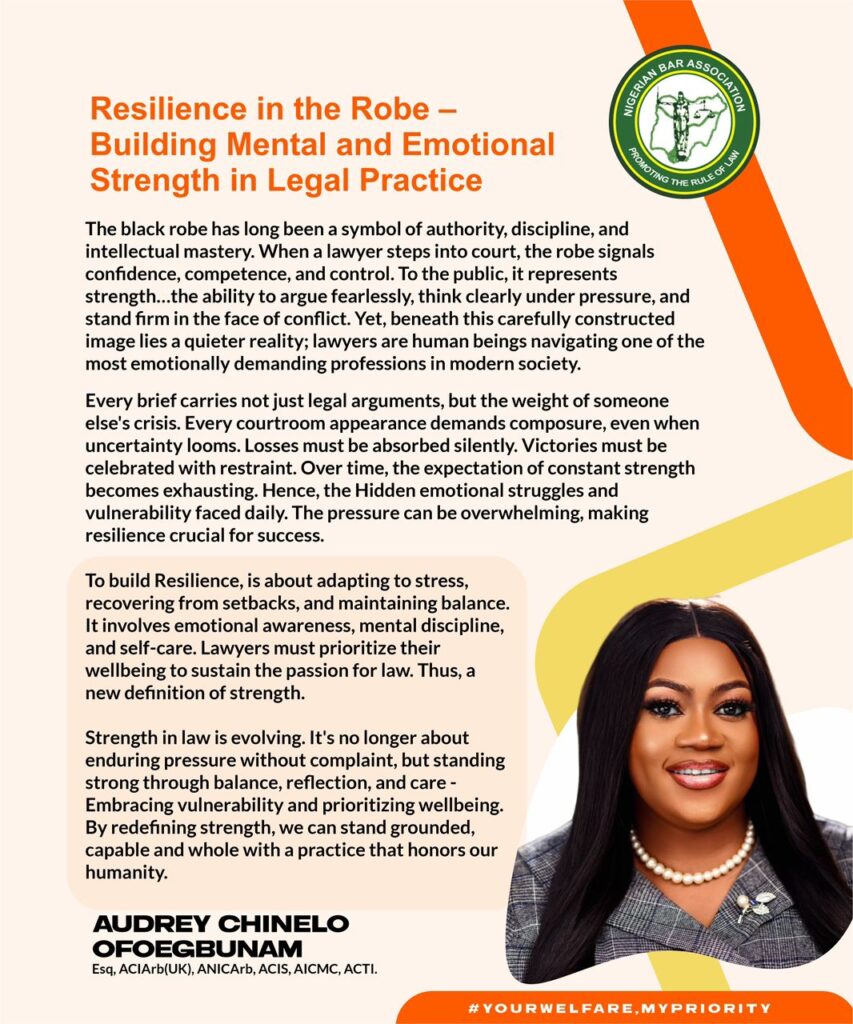
The black robe has long been a symbol of authority, discipline, and intellectual mastery. When a lawyer steps into court, the robe signals confidence, competence, and control. To the public, it represents strength—the ability to argue fearlessly, think clearly under pressure, and stand firm in the face of conflict. Yet, beneath this carefully constructed image lies a quieter reality: lawyers are human beings navigating one of the most emotionally demanding professions in modern society.
Every brief carries not just legal arguments, but the weight of someone else’s crisis. Every courtroom appearance demands composure, even when uncertainty looms. Losses must be absorbed silently. Victories must be celebrated with restraint. Over time, the expectation of constant strength becomes exhausting. In such an environment, resilience is not optional; it is essential. Not the kind of resilience that hardens the heart, but the kind that preserves clarity, balance, and emotional stability. True resilience allows the lawyer to carry the robe with dignity—without being crushed by its weight.
1. Understanding Resilience in the Legal Context
Resilience in law is often misunderstood as mere toughness—the ability to endure long hours, withstand criticism, and push through pressure without complaint. But resilience is far more nuanced. It is not about suppressing emotions or ignoring fatigue; it is about adapting intelligently to stress, recovering from setbacks, and maintaining equilibrium in the face of constant demand.
For lawyers, resilience means remaining mentally flexible while navigating adversarial environments. It is the capacity to absorb losses without losing self-worth, to receive criticism without becoming defensive, and to continue performing with integrity despite uncertainty. Resilience does not eliminate difficulty; it equips the lawyer to move through difficulty without becoming diminished by it.
Importantly, resilience is not an innate trait reserved for a few. It is a skill—developed through awareness, practice, and intentional habits. Just as legal reasoning is refined through study and experience, emotional strength can be cultivated over time. When lawyers understand resilience as a learnable competence rather than a personality trait, they begin to take ownership of their mental and emotional wellbeing.
2. The Emotional Landscape of Legal Practice
Legal practice is emotionally charged, even when it appears intellectually neutral. Lawyers routinely engage with conflict, loss, injustice, and human vulnerability. Criminal lawyers encounter stories of violence and desperation. Family lawyers witness emotional breakdowns and fractured relationships. Corporate lawyers absorb intense commercial pressure, knowing that small errors can carry enormous consequences. Each area of practice leaves its own emotional imprint.
These experiences accumulate. Over time, the constant exposure to high-stakes situations can dull emotional sensitivity or, conversely, heighten anxiety. Many lawyers begin to experience emotional fatigue—an unspoken exhaustion that does not disappear with sleep. They may feel irritable, detached, overwhelmed, or persistently on edge without fully understanding why.
The danger lies not in emotional exposure itself, but in ignoring it. When lawyers fail to acknowledge the emotional impact of their work, stress becomes internalized. What begins as pressure can evolve into burnout, cynicism, or emotional numbness. Recognizing the emotional terrain of legal practice is the first step toward resilience. Awareness allows lawyers to respond intentionally rather than react unconsciously to the demands of their profession.
3. Detachment Without Indifference – Protecting the Inner Self
One of the most delicate skills a lawyer must master is emotional detachment without indifference. Lawyers are trained to care deeply about their clients’ interests, yet they are not meant to carry every outcome as a personal burden. When the boundary between professional responsibility and personal identity becomes blurred, emotional exhaustion follows.
Healthy detachment does not mean apathy. It means understanding where the lawyer ends and the client’s problem begins. It is the ability to advocate passionately during the day and still reclaim one’s emotional space at night. Without this boundary, lawyers risk internalizing failures, reliving conflicts, and carrying stress long after the workday has ended.
Developing this form of detachment requires self-awareness and deliberate practice. It involves recognizing emotional triggers, setting mental limits, and allowing oneself to rest without guilt. Lawyers who master this balance protect not only their emotional health but also their professional effectiveness. By preserving their inner stability, they ensure that empathy remains a strength rather than a source of depletion.
4. Failure, Setbacks, and the Lawyer’s Ego
Failure in legal practice carries a unique sting. A lost case, an unfavourable ruling, a rejected argument, or a client’s disappointment can feel like a personal indictment rather than a professional outcome. For many lawyers, the ego becomes tightly intertwined with performance. Success affirms identity; failure threatens it.
Yet, resilience demands a reframing of failure—not as evidence of inadequacy, but as an inevitable companion of serious legal work. No lawyer, no matter how brilliant or experienced, wins every case. The law itself is uncertain, shaped by facts, interpretation, discretion, and human judgment. When lawyers internalize losses as personal flaws, they risk emotional collapse or chronic self-doubt.
Resilient lawyers learn to separate outcome from identity. They reflect without self-condemnation, extract lessons without dwelling in shame, and understand that professional growth often emerges from disappointment. By loosening the grip of ego, they create room for humility, learning, and emotional recovery. In doing so, setbacks become teachers rather than tormentors.
5. Mental Discipline – Training the Mind for Pressure
The legal profession is a mental battlefield. Lawyers are expected to think clearly under pressure, speak persuasively under scrutiny, and make sound judgments amid uncertainty. Without mental discipline, the constant stimulation of deadlines, disputes, and expectations can overwhelm even the sharpest minds.
Mental resilience is built through intentional habits of focus and regulation. It involves learning how to slow racing thoughts, manage anxiety before hearings, and regain composure after tense exchanges. For many lawyers, the mind rarely rests—it replays arguments, anticipates conflict, and revisits perceived mistakes long after the day has ended.
Training the mind is as important as training legal skill. Techniques such as reflection, controlled breathing, structured planning, and mindful pauses help lawyers remain grounded. A disciplined mind allows the lawyer to respond thoughtfully rather than react impulsively. Over time, this mental steadiness becomes a quiet source of confidence—one that sustains performance without draining emotional energy.
6. Emotional Literacy – Learning to Name, Process, and Release Stress
Lawyers are trained to analyze facts and interpret law, but rarely taught how to understand their own emotions. As a result, many struggle not because they feel too much, but because they do not know what they are feeling. Stress becomes anger. Fatigue becomes irritability. Fear becomes silence. Unprocessed emotions accumulate, often erupting unexpectedly.
Emotional literacy—the ability to recognize, name, and process emotions—is a cornerstone of resilience. It allows lawyers to identify when they are overwhelmed, frustrated, or depleted, rather than pushing forward blindly. Naming an emotion reduces its power; processing it prevents internal buildup.
Healthy emotional release looks different for different people. It may involve conversation, writing, exercise, quiet reflection, or creative outlets. What matters is intentional release. Lawyers who develop emotional literacy avoid the trap of emotional suppression, which often leads to burnout. Instead, they create space for renewal, allowing emotions to move through rather than settle within.
7. The Role of Routine, Rest, and Recovery
Resilience is not built only in moments of crisis; it is sustained through everyday choices. The routines lawyers adopt—their sleep habits, work patterns, and approach to rest—shape their emotional endurance more than occasional acts of self-care. A profession that glorifies exhaustion often overlooks the cost of neglecting recovery.
Rest is not weakness; it is restoration. Lawyers who consistently deny themselves rest may appear productive in the short term but often pay a long-term price in reduced focus, emotional volatility, and declining health. Recovery allows the mind to reset and the body to heal, making sustained excellence possible.
Establishing routines that protect energy is a form of professional discipline. Simple practices—setting boundaries around work hours, taking deliberate breaks, prioritizing sleep, and creating moments of quiet—accumulate into resilience over time. A lawyer who honours rest preserves not only their wellbeing but also their capacity to serve clients with clarity and integrity.
8. Community, Connection, and Shared Strength
Resilience in legal practice does not grow in isolation. While inner strength is important, it is often reinforced through connection with others who understand the unique demands of the profession. Lawyers who cultivate supportive professional relationships are better equipped to withstand stress, recover from setbacks, and maintain perspective during difficult periods.
Shared experiences create solidarity. Conversations with colleagues who have faced similar challenges remind lawyers that struggle is not a personal failing but a professional reality. Mentors provide reassurance during uncertain moments, while peers offer companionship and understanding. These connections act as emotional anchors, steadying lawyers when the pressures of practice threaten to overwhelm them.
Community transforms resilience from an individual burden into a shared resource. In environments where lawyers support one another, emotional strength multiplies. No one carries the weight alone, and collective wisdom becomes a powerful tool for endurance.
9. Ethics, Identity, and Inner Stability
A lawyer’s sense of self is deeply intertwined with professional values. When ethical principles are clear and firmly held, they provide stability in moments of pressure. Resilience is strengthened when lawyers act in alignment with their values, even in challenging circumstances.
Ethical clarity reduces internal conflict. Lawyers who know where they stand are less likely to be destabilized by external demands or moral ambiguity. They experience fewer emotional fractures because their actions reflect their convictions. This alignment between identity and practice fosters inner peace, even when outcomes are uncertain.
Resilience, therefore, is not just emotional endurance—it is moral grounding. A strong ethical compass anchors the lawyer during storms, offering direction when the profession feels chaotic or overwhelming.
10. Redefining Strength – Moving Beyond the “Hard Lawyer” Myth
For generations, strength in law has been associated with emotional silence, endurance without complaint, and relentless self-sacrifice. While these traits were once celebrated, they often left lawyers depleted and isolated. The modern understanding of resilience invites a different definition of strength.
True strength lies in adaptability, self-awareness, and the courage to care for one’s mental and emotional wellbeing. It includes the ability to seek help, to rest without guilt, and to acknowledge vulnerability without shame. Lawyers who embrace this broader vision of strength do not become weaker—they become more sustainable.
Conclusion
Resilience in the robe is not about enduring endless pressure without breaking; it is about building the capacity to recover, adapt, and continue with clarity and purpose. The legal profession will always be demanding, but resilience ensures that these demands do not erode the lawyer’s humanity.
By cultivating emotional awareness, mental discipline, ethical clarity, and supportive relationships, lawyers create a foundation for long-term wellbeing. Resilience becomes a professional asset—one that sustains integrity, enhances judgment, and preserves the joy of practicing law.
In the end, the most effective lawyer is not the one who suffers silently, but the one who stands strong through balance, reflection, and care. The robe may symbolize authority, but resilience is what keeps the lawyer standing within it—grounded, capable, and whole.
Connect with me on Social Media:
X: CIAO Legal
LinkedIn: Chinelo Audrey Ofoegbunam
Instagram: CIAO Legal
Facebook: Chinelo Ofoegbunam