
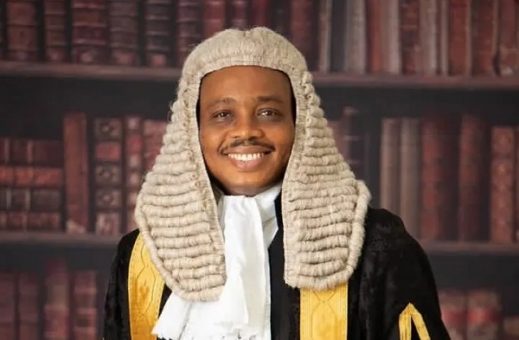
The President of the Nigerian Bar Association (NBA), Mr. Afam Osigwe (SAN), has warned that corruption within the judiciary poses a serious threat to Nigeria’s democracy, social justice, and the rule of law, calling for urgent and far-reaching reforms to restore public confidence in the justice system.
Delivering a paper titled “Judicial Corruption in Nigeria: A Menace to Democracy and Social Justice,” Osigwe described the situation as both a moral crisis and a democratic emergency.
He lamented what he called a growing public perception that the courts—constitutionally regarded as the last hope of the common man—are increasingly seen as places where justice can be delayed, manipulated, or even bought by the highest bidder.
“Democracy thrives only where the rule of law is respected,” he said. “Once the courts are seen as instruments for shielding the corrupt or persecuting political opponents, elections lose meaning, governance becomes arbitrary, and citizens lose faith in the state.”
Drawing from constitutional provisions, judicial authorities, religious texts, and empirical data, Osigwe outlined what he described as the corrosive effects of corruption within the judiciary on democratic governance.
According to him, a compromised justice system weakens the social contract between citizens and the state, discourages investment, fuels insecurity, and deepens social and economic inequality.
He cited survey findings from the United Nations Office on Drugs and Crime (UNODC), the National Bureau of Statistics (NBS), and Transparency International, noting that judges are among public officials widely perceived as vulnerable to bribery.
Osigwe urged stakeholders in the justice sector to take decisive steps to strengthen institutional integrity and safeguard the independence of the judiciary.
“When corruption infiltrates the justice sector, disproportionately harms the poor and vulnerable, turning justice into a privilege of wealth and influence rather than a right guaranteed by law,” he warned.
While acknowledging efforts by the National Judicial Council (NJC) to discipline erring judges, Osigwe argued that current measures are insufficient to rebuild trust.
He called for more decisive and transparent actions, including reforms in judicial appointments, disciplinary mechanisms, case-assignment systems, and the funding of the judiciary.
“Merit, integrity, and accountability must replace patronage and opacity,” he said, stressing that without such reforms, public confidence in the courts would continue to erode.
The NBA President also emphasized that the fight against judicial corruption is a shared responsibility.
He noted that corruption survives because there are both “corrupters and corruptees,” insisting that progress would remain elusive unless citizens refuse to offer bribes and actively report misconduct.
He urged lawyers, judges, religious institutions, traditional rulers, civil society organizations, and the media to take a firm moral stand against corruption.
“We must stop celebrating wealth of questionable origin,” Osigwe said, adding that societal values play a crucial role in sustaining or dismantling corrupt systems.
Osigwe warned that Nigeria’s democracy cannot endure with a compromised judiciary.
“History will judge the Bar and the Bench,” he said, “not by the eloquence, but by their courage to act.”
“We must stop celebrating wealth of questionable origin,” Osigwe said, adding that societal values play a crucial role in sustaining or dismantling corrupt systems.
Osigwe warned that Nigeria’s democracy cannot endure with a compromised judiciary.
“History will judge the Bar and the Bench,” he said, “not by the eloquence, but by their courage to act.”
According to him, restoring faith in the justice system is indispensable to protecting fundamental rights, strengthening democratic governance, and achieving lasting social justice in Nigeria.
Source; The Nation News