
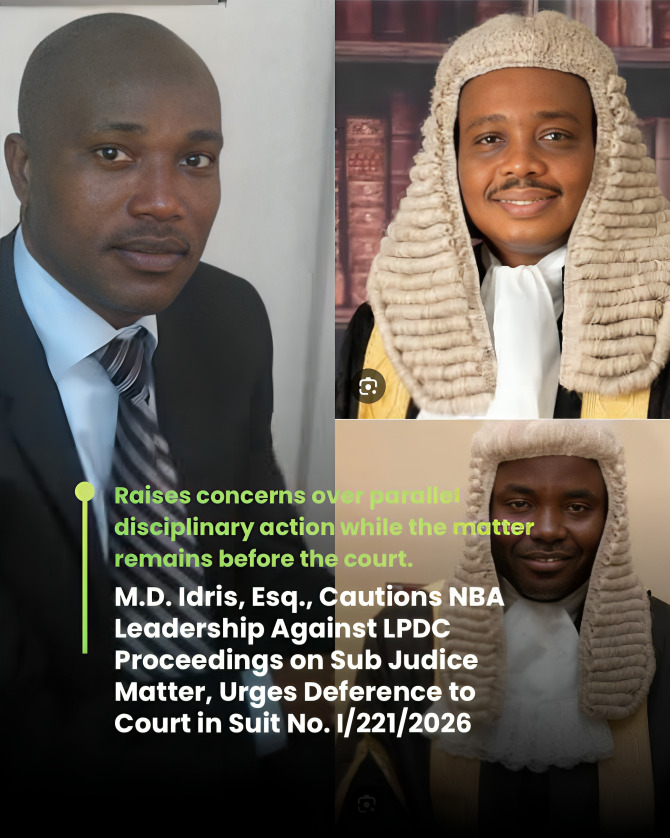
Dear Mr. President,
I have read your response with keen interest. However, with the greatest respect, the fundamental issue you seek to present as one of professional accountability is, in reality, one that is presently sub judice.
The question whether there was non-disclosure of material facts in Suit No. I/221/2026 is not one to be determined in the court of public opinion or through a petition, but one squarely within the province of the court before which the ex parte application was made. It is the court, upon full presentation of the facts and arguments by all parties, that is competent to determine whether there was suppression, misrepresentation, or breach of the duty of candour.
To elevate that same issue simultaneously before the LPDC, while the substantive matter remains pending before a court of law, raises serious concerns. It risks pre-empting the court’s decision and, more importantly, may amount to an interference with the administration of justice.
The doctrine of sub judice exists to preserve the integrity of judicial proceedings and to prevent parallel processes from reaching, or appearing to reach, conflicting conclusions on the same subject matter. Respectfully, this is a principle that should guide all of us, particularly at this level of the profession.
It is therefore a legitimate question whether, in these circumstances, the LPDC ought to entertain such a petition at all, when the issues underpinning it are directly in issue before a competent court of law. The safer and more principled course would be to allow the court first determine whether any non-disclosure occurred and its legal consequences.
Furthermore, with respect, the step taken by the Association—especially in linking the petition to consequential decisions affecting professional standing—may itself raise questions as to propriety.
Actions taken in the shadow of a pending judicial proceeding must be carefully measured to avoid any perception of institutional pressure or premature judgment.
This is not to diminish the importance of professional discipline. Rather, it is to insist that due process must be respected in its proper sequence. The court must first be allowed to perform its constitutional role without parallel adjudicatory processes running alongside it on the same facts.
In the circumstances, I respectfully urge that restraint be exercised and that full confidence be reposed in the court to determine the issues presently before it.
I reserve the right to make a more detailed response as events unfold.
Yours faithfully
M.D Idris Esq,
Lagos Branch