
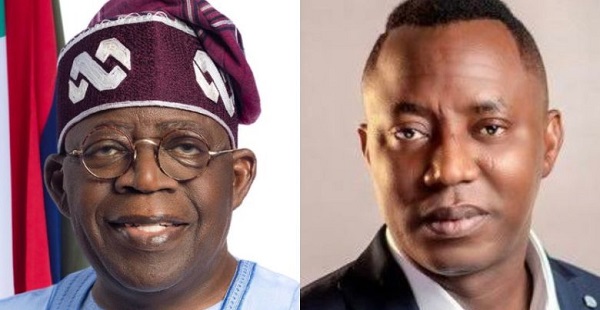
The trial of politician and online publisher Omoyele Sowore opened yesterday in the cybercrime case against him.
The prosecution called its first witness, Cyril Nosike, an official of the Department of State Services (DSS). The witness told the court that Sowore’s claim that President Bola Ahmed Tinubu was a criminal generated tension and threatened public safety.
The DSS is prosecuting Sowore for allegedly making a false claim against President Tinubu in a post he made on his X and Facebook accounts.
The defendant is accused of contravening the provisions of the Cybercrimes (Prohibition, Prevention, etc) Amendment Act, 2024.
Nosike, who was led in evidence by prosecuting lawyer, Akinlolu Kehinde (SAN), said he is stationed at the Cyber Space Monitoring Centre of the DSS and that his duty includes monitoring the cyber space for 24 hours, night and day.
The witness said in the course of his duty on August 26, last year, at the Cyber Space Monitoring Centre, he detected and monitored a post by the defendant (Sowore) through his X platform.
The DSS officer said the post referred to the President and Commander-in-Chief of the Armed Forces, about whom Sowore said: “This criminal @OfficialABAT actually went to Brazil to state that there is no MORE corruption under his regime in Nigeria. What audacity to lie shamelessly!”
The witness said when he came across the video, which Sowore allegedly posted and under which the defendant wrote the statement, he (the witness) downloaded it and saved it in a flash drive and marked it XYZ.
When shown the flash drive and a certificate of compliance, he identified them as the items he referred to.
The prosecuting lawyer then applied to tender them in evidence. Defence lawyer, Marshall Abubakar, said he would reserve his objection, which he intended to raise at the appropriate time.
Justice Mohammed Umar admitted the flash drive and the certificate in evidence.Kehinde applied that the flash drive be played in the open court for everyone to see, a request the judge granted.
The court played the video clip in the flash drive.
The video showed President Tinubu speaking about the achievements of his administration and encouraged Brazilian businesses to invest in Nigeria because there is now a conducive business environment that is devoid of corruption.
Shortly after the video was played, Kehinde noticed that Sowore, who stood in the dock, was using his mobile phone in the course of the court’s proceedings.
The lawyer complained to the judge.
Although Sowore attempted to deny using his phone, Justice Umar frowned at the attitude, saying it was wrong for a defendant to use a phone while the court was sitting.
The judge directed an official of the court to retrieve the phone from the defendant and hand it over to his lawyer.
Sowore refused to hand the phone to the lawyer, who moved close to him in the dock to retrieve the device.
He told the court official: “Don’t touch my phone.”
Sowore sought the court’s permission to hand the phone to his lawyer by himself, a request the court granted.
The defendant thereafter walked off the dock and handed the phone to his lawyer, who was standing a few metres away.
The judge directed Abubakar to place the phone on top of the table in front of the court.
At the resumption of his testimony, Nosike said he made a screenshot of the attendant reactions of people to Sowore’s post on President Tinubu’s video.
The witness said seeing the reactions to Sowore’s post, the DSS wrote official letters to the owners of the X platform and Facebook (Meta) through their email addresses.
The witness said the letters were for the two social media platforms to take down Sowore’s post, “considering that the statement on that post was generating tension”.
He said the DSS also sent an official letter to the defendant through his lawyers, who acknowledged receipt of the letter.
Nosike also said the letter was meant to make Sowore retract his inciting post.
The DSS official explained that even though the letter to him was a confidential document, Sowore posted a screenshot of the letter on his Facebook platform.
The witness added: “As expected, the letter (which Sowore posted on Facebook) attracted reactions from Nigerians, both far and wide.
“…The reactions to that letter were disparaging to the DSS and painted the service in a bad light.
Kehinde tendered copies of the letters the witness referred to and his screenshots of the reactions to Sowore’s posts, which the court admitted in evidence.
Nosike told the court that Sowore’s inciting posts complicated the work of security agencies like the DSS.
He said: “We have officers and men who have sworn on oath to put themselves on the line for the security and stability of this country.
“Such inciting posts that generate tension make our work more difficult, and we take such issues very seriously,” he said.
At the conclusion of his evidence, the court directed Sowore’s lawyer to cross-examine the witness.
But Abubakar begged the court for time to enable him study the witness’s testimony before he could cross-examine Nosike.
Although Kehinde objected to the adjournment the defence sought, arguing that there was no basis for it, the judge agreed to adjourn the case but rejected Abubakar’s request for a date in February.
Justice Umar adjourned till January 27 for cross-examination and continuation of the hearing.
Abubakar had made efforts to frustrate the planned commencement of trial in the case.
The lawyer claimed that the prosecution did not serve him the summary of witnesses’ testimonies and other relevant materials, as ordered by the court on the last adjourned date.
He averred that in view of the alleged failure of the prosecution to comply with the court’s order, the defence had filed a motion for the striking out of the charge.
But when the judge asked a court official to hand Abubakar a copy of the proof of service, which Kehinde had earlier submitted to the court, the defence lawyer glanced at the documents and claimed that they were forged.
The lawyer also claimed that there was a disparity in the dates on the documents.
But when his attention was drawn to the fact that the documents emanated from the court, he admitted service and apologised to both the prosecution and the court.
It was at that point the judge ordered the prosecution to call its first witness.
Source; The Nation News