
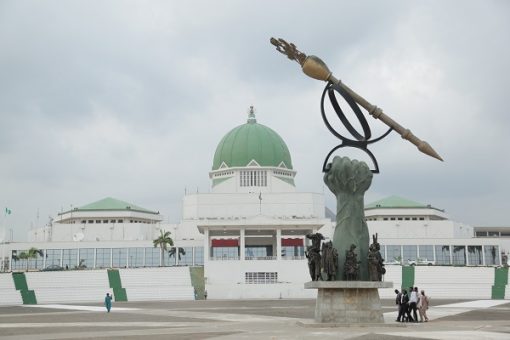
The joint National Assembly Committee on the Review of the 1999 Constitution has proposed an amendment that will ensure that all election petitions are concluded before winners of such polls are sworn in.
The Nation reports that the National Assembly’s joint committee also recommended a 60-day period for the disposal of election petitions at the tribunal level and another 60 days for disposal of appeals arising from the judgment of the lower tribunal in all post-election matters.
By the recommendations, the Supreme Court is expected to assume original jurisdiction in all petitions arising from the conduct of the presidential elections, while appeals from the governorship elections are to end at the Court of Appeal.
These recommendations are contained in the 44 Bills harmonised and agreed upon by the joint committee and constitute the first batch of prioritised constitution alteration Bills presented at plenary of the Senate and the House of Representatives for debates.
The lawmakers proposed an amendment to Section 232 of the Constitution to provide that “the Supreme court shall, to the exclusion of any other court of law in Nigeria, have original jurisdiction to hear and determine any question as to whether (a) any person has been validly elected to the office of President or Vice President under this Constitution, (b) the term of office of the President or Vice President has ceased, or (c) the office of President or Vice President has become vacant”.
The amendment to the section also states: “In the hearing and determination of any election petition under subsection (1A), the Supreme Court shall be duly constituted if it consists of at least five Justices of the Supreme Court. In every Presidential election petition, the Supreme Court shall deliver its judgement in writing within 60 days of filing of the suit.”
The joint committee also recommended alteration to Section 239, which provides that “(1) Subject to the provisions of this Constitution, the Court of Appeal shall, to the exclusion of any other court of law in Nigeria, have original jurisdiction to hear and determine any question as to whether: (a) any person has been validly elected to the office of Governor or Deputy Governor under this constitution; (b) the terms of office of the governor or deputy governor has ceased; or (c) the office of governor or deputy governor has become vacant”.
It also provides that “In every Governorship election petition, the Court of Appeal shall deliver its judgement in writing within 60 days of filing the suit”.
The joint ommittee also proposed an amendment to Section 286, which provides the time for determination of pre-election matters, establishment of an election tribunal and the time for the determination of election petitions.
It proposed altering Sub-section 6 by replacing 180 days as the time line for disposing off election petition with 60 days, stating: “An election tribunal shall deliver its judgement in writing within 60 days from the date of filing of the petition.”
Similarly, Sub-section 7 is also recommended for amendment to read: “An appeal from the decision of an election tribunal or court in an election petition shall be heard and disposed of by the Court of Appeal within 60 days from the date of filing the appeal (old provision says 60 days from the date of judgement).
Pre-election matters are also to also be disposed of within 60 days from the date of filing the suit, while appeals in all pre-election matters are to be disposed of within 30 days from the date of filing the appeal.
Making provision for Independent candidacy in elections at all levels, the lawmakers proposed that to qualify to contest, the person running as an independent candidate must get at least 20 per cent of registered voters in each of the electoral wards in the constituency where he is contesting the elections.
The proposed amendments states that a person endorsing the independent candidate must not endorse two candidates to contest elections at a given period of time, while the Independent National Electoral Commission (INEC) is expected to verify such endorsements.
The independent candidate is also expected to pay an administrative fee to be determined by the INEC, “provided that the Independent National Electoral Commission shall waive 50 per cent of the administrative fees for women candidates”.
In addition, the proposed alterations seek to place the funding of the Armed Forces on the first line charge with the alteration of Section 81, which deals with authorisation of expenditure from the consolidated revenue fund and amended to include the Armed Forces.
Federal bodies already listed in the Constitution to draw funding on first line charge are: the Independent National Electoral Commission, the National Assembly, and the Judiciary.
The joint committee also proposed an amendment to Sub-section 1 of Section 81 and Section 121(1) to provide maximum of 60 day before the end of the year for the President and governors to prepare and submit estimates of revenues and expenditure for the succeeding year to the National and state Houses of Assembly.
Source; The Nation News