
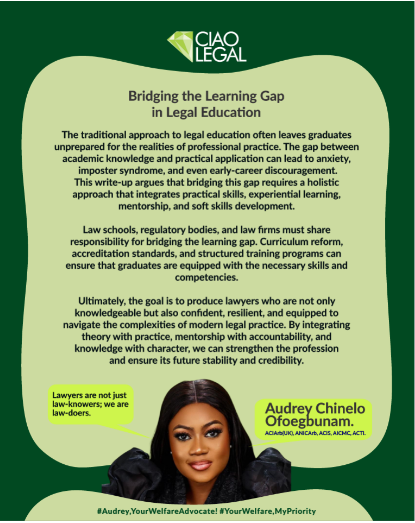
BRIDGING THE LEARNING GAP IN LEGAL EDUCATION
In the classroom, the law is structured, orderly, and predictable. Principles are
distilled into lectures. Cases are analyzed in hindsight. Examinations test recall,
reasoning, and analytical clarity. Within that academic environment, success is
measurable and contained. A student masters doctrine, cites authority correctly,
and graduates with distinction.
The courtroom, however, tells a different story. It is dynamic, pressured, and
often unpredictable. Clients arrive not with theoretical problems, but with urgent,
messy realities. Deadlines loom. Opposing counsel challenge arguments in real
time. Judges interrupt. Negotiations unfold without scripts. In this world,
knowledge alone is insufficient; judgment, communication, and composure are
equally critical.
Academic excellence, though admirable, does not automatically translate into
professional readiness. A graduate may understand constitutional principles yet
struggle to draft a clear originating process. One may recite procedural rules yet
feel uncertain when addressing a judge for the first time. The gap between
knowing the law and practicing it can be wider than anticipated.
For many young lawyers, this gap produces anxiety. The transition from lecture
halls to live files can feel abrupt and disorienting. Expectations shift instantly—
from student to professional, from observer to advocate. Mistakes carry
consequences. Confidence may waver. What was once theoretical becomes
personal and immediate.
The learning gap is therefore not merely an academic issue; it is a welfare
concern. When graduates enter practice underprepared, stress intensifies.
Imposter syndrome deepens. Early-career discouragement becomes more likely.
Bridging this gap is essential not only for competence, but for professional
sustainability.
- The Theory–Practice Divide
Legal education traditionally emphasizes doctrinal mastery. Students learn
statutory interpretation, case analysis, and jurisprudential reasoning. These
foundations are indispensable. A lawyer must understand the law before applying
it. Yet mastery of doctrine is only one component of professional competence.
Practical application often receives less structured attention. Drafting pleadings,
negotiating settlements, interviewing clients, managing case files, and presenting
oral arguments are skills typically acquired informally sometimes through
observation, sometimes through trial and error. Without guided practice,
graduates may enter the profession with strong theoretical knowledge but limited
practical fluency.
Exposure to real-world dynamics is frequently limited during formal education.
Students rarely manage live clients independently. They may study procedural
rules without filing documents themselves. They may analyze appellate
judgments without ever standing before a judge. The classroom rewards precision
in thought; the courtroom demands precision in action.
The transition can therefore be jarring. Young lawyers often describe their first
court appearance as intimidating. Drafting the first substantive document without
a template can feel overwhelming. Managing client expectations requires
emotional intelligence not fully cultivated through lectures alone.
Entering practice underprepared carries consequences. Mistakes may erode
confidence. Supervisors may assume competence where guidance is needed. The
early professional experience can shift from growth to survival. Over time, this
strain may shape career decisions some withdrawing from litigation not because
of lack of aptitude, but because of avoidable anxiety.
Bridging the theory–practice divide does not require abandoning doctrinal rigor.
It requires complementing it with intentional experiential learning. Legal
education must prepare graduates not only to understand the law, but to perform
it competently and confidently. - Practical Skills Every Graduate Needs
If doctrinal knowledge forms the skeleton of legal education, practical skills
provide its muscle and movement. Without them, competence remains
theoretical.
Legal drafting is perhaps the most immediate test of readiness. Graduates must
be able to draft clear pleadings, coherent contracts, structured legal opinions, and
persuasive correspondence. Drafting is not merely about language; it is about
strategy. A well-drafted originating process frames a case. A carefully structured
contract anticipates risk. A precise opinion guides decision-making. Yet many
young lawyers encounter their first independent drafting assignment without
formal training in structure, tone, or practical formatting standards.
Oral advocacy and courtroom etiquette are equally critical. Knowing the law is
different from articulating it under scrutiny. Courtroom advocacy demands
clarity, brevity, confidence, and respect for procedure. Understanding when to
rise, how to address the bench, and how to respond to judicial interruption are not
intuitive skills they are learned behaviors. Without rehearsal and guided
exposure, young lawyers may feel unsteady in their earliest appearances.
Negotiation and alternative dispute resolution techniques are increasingly
essential. Not every matter proceeds to trial. The ability to negotiate effectively,
identify mutual interests, and structure settlement terms can determine client
satisfaction and case outcomes. These skills require emotional intelligence,
listening ability, and strategic framing competencies that extend beyond case law
analysis.
Client interviewing and communication skills sit at the heart of legal practice.
Lawyers must translate complex legal concepts into understandable advice. They
must ask the right questions to uncover facts. They must manage expectations
with empathy and honesty. Poor communication can undermine even strong legal
positions. Yet structured training in client interaction is often minimal.
Time management and professional organization complete the skill set. Legal
practice involves juggling multiple deadlines, court dates, filings, and
consultations. Without systems for prioritization and documentation, even
capable lawyers can become overwhelmed. Early mastery of organization
reduces stress and enhances reliability.
These practical skills do not diminish academic rigor; they operationalize it.
Graduates who combine doctrinal knowledge with practical competence enter the
profession not merely qualified, but prepared. - Clinical Legal Education and Experiential Learning
Bridging the learning gap requires more than theoretical adjustment it demands
structured experience. Clinical legal education offers one of the most effective
pathways for translating knowledge into practice.
Law clinics allow students to engage with real clients under supervision. Drafting
letters, conducting interviews, and assisting in live matters provide invaluable
exposure. Mistakes made within supervised environments become lessons rather
than liabilities. Confidence grows through guided participation.
Moot courts also play a significant role. Simulated advocacy sharpens research,
writing, and oral presentation skills. Standing before evaluators even in simulated
settings reduces the intimidation factor of real courtrooms. Repetition builds
familiarity. Familiarity builds composure.
Internships and externships extend learning beyond campus walls. Exposure to
law firms, courts, government agencies, and corporate legal departments reveals
the practical rhythms of professional life. Observing file management systems,
client meetings, and courtroom procedures contextualizes classroom theory.
The value of supervised real-world exposure lies in its structure. Experience alone
is not sufficient; guidance is essential. Constructive feedback from experienced
practitioners accelerates development. Clear evaluation criteria reinforce
standards of professionalism.
Partnerships between law faculties and practicing professionals strengthen this
bridge. Guest lectures, adjunct teaching roles, collaborative workshops, and
practitioner-led training sessions ensure curriculum relevance. When academia
and practice communicate consistently, gaps narrow.
Expanding access to experiential opportunities is critical. Not all students
currently benefit equally from clinics or internships. Structured inclusion ensures
that career preparedness is not reserved for the well-connected or privileged.
Clinical education transforms legal training from abstract mastery into applied
competence. It equips graduates not only to understand the law, but to navigate
its living practice with confidence and integrity. - Mentorship and Structured Apprenticeship
The transition from academic study to professional practice should not be abrupt;
it should be guided. Mentorship and structured apprenticeship are critical bridges
between qualification and competence. Without them, the early years of practice
risk becoming a period of avoidable confusion and silent struggle.
A guided transition into practice allows young lawyers to move from observation
to responsibility in measured stages.
Rather than being handed complex tasks without context, they benefit from
supervised drafting, shadowed court appearances, and progressive exposure to
client management. Structured learning within firms builds both skill and
confidence.
Clear expectations during pupilage are essential. Young lawyers need to
understand what is required of them, how performance will be evaluated, and
what growth benchmarks exist. Ambiguity breeds anxiety. Transparent feedback
mechanisms—regular reviews, constructive critique, and open dialogue—turn
mistakes into learning opportunities rather than sources of embarrassment.
Reducing exploitation disguised as “experience” is equally important. Exposure
should not mean unpaid or underpaid labor without guidance. Where young
lawyers perform substantive work, fair compensation and structured mentorship
must accompany it. Experience is valuable, but it should not come at the expense
of dignity or financial stability.
Mentorship, at its best, is not merely supervision; it is advocacy. A true mentor
invests in a young lawyer’s growth, provides honest counsel, models
professionalism, and creates opportunities for visibility. Through mentorship,
competence develops faster, confidence stabilizes, and professional identity
begins to take shape.
When apprenticeship is structured rather than incidental, the learning gap
narrows. Young lawyers move from academic understanding to practical mastery
with greater clarity and less distress. - Financial Literacy and Career Preparedness
Legal education often focuses intensely on substantive law, yet pays limited
attention to the financial realities of legal practice. This omission leaves many
graduates professionally knowledgeable but economically unprepared.
Young lawyers must understand billing structures, fee arrangements, and
compensation models. Whether operating within hourly billing systems,
retainers, milestone-based fees, or fixed-fee arrangements, financial literacy
empowers lawyers to make informed career decisions. Knowledge of taxation,
regulatory dues, and operational costs prevents costly mistakes.
Understanding career pathways is equally vital. Litigation, corporate practice,
public service, academia, in-house roles, and entrepreneurship each carry distinct
financial and lifestyle implications. Early exposure to these pathways allows
graduates to align choices with strengths, temperament, and long-term goals
rather than following default trajectories.
Preparation for entrepreneurship is particularly important. Many lawyers
eventually consider solo practice or partnership. Without foundational knowledge
of budgeting, cash flow management, client acquisition, and overhead planning,
this transition can be financially destabilizing. Structured exposure to business
fundamentals equips graduates to approach independence strategically rather than
impulsively.
Managing debt and early-career financial instability is another critical dimension.
Student loans, modest entry-level salaries, and irregular earnings can create stress
that undermines professional confidence. Teaching budgeting, savings discipline,
and long-term planning reduces vulnerability during these formative years.
Financial literacy is not separate from professional competence it supports it.
Lawyers who understand their economic environment make better strategic
decisions, negotiate more confidently, and build sustainable careers.
Bridging the learning gap therefore requires more than teaching legal doctrine. It
requires equipping graduates with the practical, financial, and professional tools
necessary not only to practice law, but to thrive within it. - Soft Skills and Professional Identity Formation
Technical knowledge may open the door to the profession, but soft skills
determine how successfully one remains within it. Legal practice is deeply
human. It involves managing expectations, resolving conflict, persuading
decision-makers, and maintaining composure under pressure. These demands
require emotional intelligence and resilience.
Emotional intelligence enables lawyers to read client anxieties, respond
appropriately to opposing counsel, and adapt communication styles to different
audiences. It allows practitioners to separate criticism of an argument from
criticism of self. Without this awareness, professional stress intensifies and
workplace friction becomes more likely.
Resilience complements emotional intelligence. The ability to recover from
setbacks—lost motions, difficult negotiations, or judicial criticism—is essential
for long-term sustainability.
Ethics and professionalism form the backbone of legal identity. Beyond
memorizing professional conduct rules, students must internalize what integrity
looks like in daily practice. Reputation management begins early. Reliability,
discretion, punctuality, and respect for colleagues build trust. In a profession
where referrals and relationships matter, character is capital.
Confidence-building is equally critical. Many capable graduates struggle not
from lack of knowledge, but from hesitation in expression. Public speaking
exercises, simulated advocacy, and structured presentation opportunities cultivate
assurance. Confidence grounded in preparation reduces anxiety and enhances
credibility.
Navigating workplace dynamics and office politics is another often-overlooked
skill. Law offices are ecosystems with hierarchies, personalities, and competing
priorities. Understanding how to communicate respectfully upward, collaborate
laterally, and supervise downward becomes increasingly important over time.
Without guidance, young lawyers may misinterpret feedback or mismanage
professional relationships.
Professional identity formation is therefore a deliberate process. It involves
aligning values with conduct, cultivating resilience, and developing the
interpersonal maturity required for sustained practice. Legal education that
ignores this dimension leaves graduates technically informed but socially
unprepared. - Technology and Modern Legal Practice
Legal practice is no longer confined to physical libraries and paper files.
Technology has reshaped research, communication, documentation, and dispute
resolution. Career preparedness now requires digital fluency.
Modern legal research platforms allow for rapid case retrieval, cross-referencing,
and analytics. Mastery of these tools enhances efficiency and depth of argument.
Similarly, digital case management systems streamline file organization, deadline
tracking, and client communication. Lawyers who understand these systems
operate with greater precision and reduced administrative stress.
Virtual advocacy has become increasingly prominent. Remote hearings,
electronic filing systems, and online dispute resolution platforms demand new
competencies. Presenting arguments through digital interfaces requires clarity,
technical preparedness, and adaptability. Lawyers must be comfortable managing
both substance and technology simultaneously.
Artificial intelligence and automation are also reshaping practice. Document
review tools, contract analysis software, and predictive analytics assist in
streamlining tasks traditionally performed manually. While technology cannot
replace judgment, it can enhance productivity.
Graduates who understand how to leverage AI ethically and effectively will
remain competitive in evolving markets.
Preparing students for technological landscapes requires intentional curriculum
integration. Exposure to digital tools during training ensures that adaptation does
not occur under pressure after qualification.
Technological competence should be viewed not as optional enhancement, but as
foundational literacy.
The future of legal practice will continue to evolve. Lawyers who combine
doctrinal knowledge, practical skill, emotional intelligence, and technological
fluency will be best positioned to thrive. Bridging the learning gap, therefore,
means preparing graduates not only for the profession as it exists today, but for
the profession as it is becoming. - Institutional Responsibility – Law Schools and Regulatory Bodies
Bridging the learning gap cannot rest solely on individual initiative. Institutional
reform is essential. Law schools and regulatory bodies shape the structure,
priorities, and expectations of legal education. If preparedness is to improve,
reform must begin at this level.
Curriculum reform should aim for deliberate balance. Doctrinal rigor must remain
intact, but practical application should no longer be peripheral. Drafting
workshops, simulated client conferences, negotiation labs, and structured
advocacy exercises can coexist with traditional lectures. The objective is not to
dilute theory, but to operationalize it.
Continuous curriculum review informed by practitioners is equally critical. The
realities of modern practice evolve—technology advances, client expectations
shift, procedural rules change. Academic programs must reflect these
developments. Structured engagement with law firms, judges, and in-house
counsel ensures that training remains relevant rather than abstract.
Accreditation standards can also play a transformative role. If regulatory
frameworks explicitly prioritize career readiness, institutions will be incentivized
to embed practical competencies within their programs. Evaluation metrics
should extend beyond examination performance to include experiential learning
opportunities and professional skill development.
Collaboration between academia, the bench, and the bar strengthens coherence
across the profession. Guest lectures from judges, mentorship programs led by
senior practitioners, and joint training initiatives create continuity between
education and practice. When institutional silos dissolve, the learning gap
narrows.
Reform at this level signals that career preparedness is not an optional
supplement—it is a core responsibility. - The Role of Law Firms and Senior Practitioners
Even the most thoughtfully designed curriculum cannot replace the formative
influence of early professional environments. Law firms and senior practitioners
serve as the immediate bridge between academic preparation and real-world
responsibility.
Structured training programs within firms are essential. Rather than assuming that
young lawyers will “learn on the job” without guidance, firms can implement
formal onboarding processes, drafting workshops, supervised advocacy sessions,
and regular feedback meetings. This structure transforms trial-and-error learning
into guided development.
Transparent expectations during early practice reduce anxiety. Young lawyers
perform best when they understand standards, deadlines, and performance
benchmarks. Clear communication about responsibilities and progression
pathways fosters confidence and accountability.
Investment in long-term skill development reflects institutional vision.
Supporting continuing legal education, sponsoring advocacy courses, and
encouraging specialization demonstrate commitment to growth beyond short
term output. When firms prioritize development, they cultivate loyalty and
excellence.
Equally important is the creation of safe environments for questions and growth.
Fear of appearing incompetent can silence necessary inquiries. Senior
practitioners who model humility, share their own early-career challenges, and
invite dialogue foster psychological safety. In such environments, mistakes
become lessons rather than liabilities.
The transition from graduate to competent practitioner is a shared responsibility.
Law firms that embrace this role strengthen not only their teams, but the
profession at large. - Toward a Holistic Model of Legal Education
The ultimate objective is not incremental adjustment, but holistic integration.
Legal education must move toward a model that combines knowledge, skill,
ethics, and wellbeing.
Preparing lawyers solely to pass examinations is insufficient. Professional
sustainability demands emotional resilience, ethical grounding, technological
competence, and financial literacy. These elements should not be scattered add
ons; they should be woven into the fabric of training.
Alignment with modern legal realities is essential. The profession today involves
digital tools, alternative dispute resolution mechanisms, cross-disciplinary
collaboration, and evolving client expectations. Education must anticipate these
realities rather than react belatedly.
Bridging the gap between classroom and courtroom enhances not only
competence, but confidence. Graduates who enter practice prepared are less
likely to experience professional shock. They are more likely to remain engaged,
innovate responsibly, and contribute meaningfully.
A holistic model recognizes that legal training shapes human beings, not merely
technicians. Sustainable professional development begins at the educational
foundation.
Conclusion
Certification marks entry into the profession, but it does not guarantee readiness.
Moving beyond qualification toward genuine competence is both an institutional
and professional imperative.
When graduates are thrust into practice without adequate preparation, the
consequences extend beyond individual discomfort. Confidence erodes. Errors
multiply. Attrition increases. Preventable professional shock undermines long
term sustainability.
Strengthening preparation systems strengthens the profession itself. When
education integrates theory with practice, mentorship with accountability, and
knowledge with character, young lawyers enter the field equipped rather than
overwhelmed.
True legal education prepares lawyers not only to know the law, but to practice it
with confidence, integrity, and resilience. Bridging the learning gap is therefore
not merely an academic reform—it is an investment in the future stability and
credibility of the legal profession.
Connect with me on Social Media:
X: CIAO Legal
LinkedIn: Chinelo Audrey Ofoegbunam
Instagram: CIAO Legal
Facebook: Chinelo Ofoegbunam