
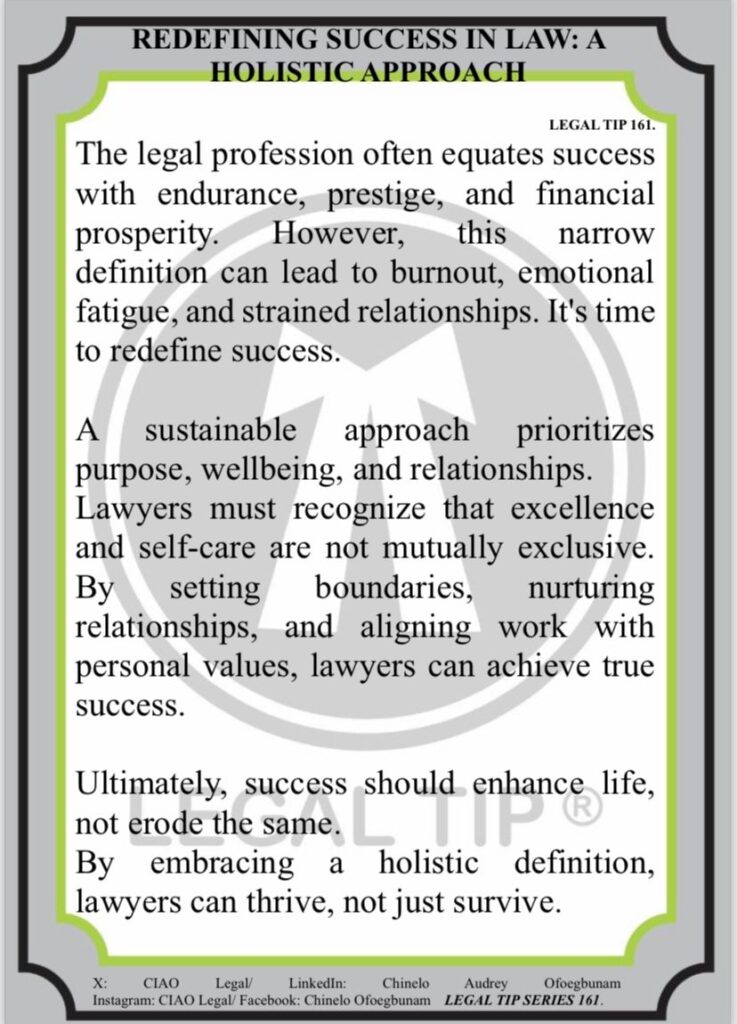
Redefining Success – A holistic approach; How Lawyers Can Pursue Purpose Without Sacrificing Well-being
By Audrey ChineloOfoegbunam
Introduction
From the first day a lawyer announces their call, society begins to define success for them – prestige, influence, financial prosperity, the corner office, the silk robe, the public recognition that accompanies courtroom victories and corporate triumphs. In the legal profession, success has long been measured by visible markers—titles earned, income accumulated, and reputation established.
These markers are not inherently wrong. Achievement deserves recognition, and excellence should be rewarded. Yet the pursuit of external validation often comes at a quiet cost. Long hours are worn as badges of honour. Exhaustion is reframed as dedication. Personal sacrifices are dismissed as necessary steps toward greatness. The lawyer learns early that admiration follows visible accomplishment, not visible balance.
And so, many lawyers reach milestones they once dreamed of—partnership, financial comfort, professional prominence only to find themselves tired, disconnected, or quietly unfulfilled. The applause is real, but so is the fatigue. The success is tangible, but so is the strain.
The question, then, is not whether success is attainable. It is whether the traditional definition of success is sustainable. If achievement demands constant self-denial, if prestige erodes peace, and if survival replaces fulfilment, then perhaps the profession must reconsider what it truly means to succeed.
Redefining success does not mean lowering standards. It means expanding them. It means recognizing that purpose, health, relationships, and integrity are not distractions from professional accomplishment. However, they are integral to it.
- The Success Script Lawyers Inherit
Before lawyers ever draft their first brief, they inherit a script. It is written by society, reinforced by mentors, and echoed within professional circles. The script is clear: work harder than everyone else, outperform your peers, and measure your worth by visible progress. Success is linear. Advancement is proof of value. Slowing down is a risk.
From law school onward, comparison becomes constant. Grades, internships, chambers placements, firm rankings—each milestone becomes a marker of relative standing. This culture of comparison subtly conditions lawyers to equate identity with performance. Over time, the habit of measuring oneself against others becomes internalized, shaping professional decisions long after formal assessments have ended.
The culture of overwork is often normalized early. Staying late is interpreted as commitment. Taking on additional files is seen as initiative. Declining assignments can feel like weakness. In such an environment, boundaries are quietly eroded. What begins as ambition gradually evolves into compulsion.
Early career conditioning has long-term consequences. Habits formed in the pursuit of validation—constant availability, reluctance to rest, fear of appearing inadequate—solidify into professional identity. The lawyer becomes reliable, driven, and accomplished. Yet beneath this discipline, self-neglect may take root.
Ambition, when unbalanced, becomes a double-edged sword. It fuels growth, but it can also silence internal warnings. Sleep becomes optional. Relationships are postponed. Health is deferred. Over time, the line between dedication and depletion blurs.
Recognizing the inherited success script is the first step toward rewriting it. Lawyers need not abandon ambition—but they must examine whether their pursuit of excellence is guided by purpose or driven by pressure. True success should strengthen the individual, not quietly diminish them.
- The Hidden Cost of Conventional Achievement
Conventional achievement in law often looks impressive from the outside. Promotions are celebrated, Income rises, Professional recognition expands. Yet beneath these visible milestones, many lawyers quietly absorb costs that are rarely acknowledged in public narratives of success.
Burnout is one of the most common consequences. It does not always arrive dramatically; it creeps in gradually. The early enthusiasm that once fueled late nights begins to fade. Energy becomes harder to restore. Concentration weakens. What was once passion turns into obligation. In a profession that prizes endurance, burnout is often ignored until it manifests as illness, irritability, or disengagement.
Relationships also bear the strain. Missed family events, postponed vacations, and emotional unavailability accumulate over time. The lawyer who is constantly “on call” professionally may become increasingly distant personally. Success may bring financial comfort, but without time autonomy—the ability to control one’s schedule—it offers limited freedom.
Health decline is another hidden cost. Prolonged stress elevates blood pressure, disrupts sleep, and weakens immunity. Sedentary routines and irregular meals compound the problem. Yet because legal work is intellectually demanding rather than physically strenuous, its bodily impact is underestimated. The mind is celebrated; the body is neglected.
Perhaps most subtle is emotional fatigue. Professional accolades can mask internal depletion. The praise received after a successful case or major transaction may temporarily restore confidence, but it cannot permanently replenish energy. Constant performance always appearing composed, competent, and confident
exacts a psychological toll. The pressure to maintain reputation can prevent honest conversations about struggle.
When success becomes synonymous with perpetual output, lawyers risk equating their worth with productivity. Rest begins to feel indulgent. Slowing down feels dangerous. The result is a cycle where external validation compensates for internal exhaustion until it no longer can.
- Purpose as a Sustainable Driver
If prestige and performance alone are insufficient to sustain wellbeing, what can replace them as the primary driver of success? The answer lies in purpose.
Purpose differs fundamentally from prestige. Prestige seeks recognition; purpose seeks meaning. Prestige is measured externally—titles, awards, income. Purpose is measured internally—alignment with values, impact on others, personal fulfillment. While prestige fluctuates with circumstance, purpose offers steadier grounding.
For lawyers, aligning work with personal values can transform professional experience. This alignment may take many forms: advocating for vulnerable communities, building ethical corporate practices, mentoring younger colleagues, or simply practicing law with integrity and fairness. When lawyers understand why they do what they do, pressure becomes more manageable.
Purpose also expands the definition of impact. Success need not be confined to financial growth or public visibility. It may include improving a client’s stability, contributing to institutional reform, or creating a balanced firm culture. Meaningful impact often occurs quietly, without applause.
In high-pressure careers, purpose acts as a stabilizing force. It reframes setbacks as part of a larger mission rather than as personal failure. It provides motivation that does not depend solely on comparison. When ambition is guided by purpose rather than by fear of inadequacy, it becomes sustainable.
This does not mean ambition disappears. Instead, it becomes anchored. Lawyers can still pursue excellence, but with clarity about what truly matters. Purpose transforms success from a race into a journey—one that can be sustained without sacrificing health, relationships, or peace of mind.
- Redefining Productivity and Performance
For generations, productivity in legal practice has been measured by volume—hours billed, files handled, emails answered, meetings attended. Output became the visible currency of dedication. The lawyer who stayed longest was presumed most committed. The one constantly occupied was deemed indispensable.
Yet endless output is not synonymous with excellence. In fact, prolonged overextension often diminishes precision, creativity, and judgment—the very qualities the profession depends upon. Fatigue narrows perspective. Overwork increases errors. Decision-making weakens under chronic stress. The myth that longer hours equal greater value persists largely because busyness is visible, while intentional excellence is quieter.
Intentional excellence requires focus, preparation, and thoughtful execution. It values depth over volume. It recognizes that strategic rest enhances cognitive performance and that clarity cannot be forced through exhaustion. Lawyers who prioritize quality over sheer quantity often deliver more sustainable impact.
Setting boundaries does not diminish ambition; it refines it. Boundaries protect time for preparation, reflection, and renewal. They signal professionalism, not indifference. Learning to decline unnecessary commitments, delegate responsibly, and structure workdays with intention allows lawyers to preserve both energy and enthusiasm.
Sustainable performance contrasts sharply with short-term intensity. Short bursts of effort may achieve immediate results, but when intensity becomes permanent, it erodes resilience. A career in law is not a sprint—it is a marathon requiring pacing, strategy, and endurance. Redefining productivity means recognizing that longevity, not exhaustion, is the true measure of professional strength.
- Well-being as a Professional Asset
Well-being is often discussed as a personal concern, separate from professional ambition. In reality, it is a critical professional asset. Physical health supports stamina in long trials and negotiations. Mental clarity sharpens analysis. Emotional resilience strengthens client relationships and leadership effectiveness.
A lawyer who sleeps adequately, exercises consistently, and maintains balanced nutrition approaches work with sharper focus and steadier judgment. Conversely, chronic stress, sleep deprivation, and neglect of physical health impair concentration and increase irritability. The connection between wellbeing and performance is not abstract—it is practical and measurable.
Rest and recovery are frequently misunderstood as indulgences. In high-performing environments, taking time off can feel like falling behind. Yet neuroscience and experience affirm the opposite: recovery enhances productivity. The mind consolidates information during rest. The body repairs itself. Creativity often emerges when pressure subsides.
Integrating wellness practices into daily legal routines does not require dramatic lifestyle overhauls. It begins with small, consistent habits—structured breaks, movement between meetings, mindful breathing before court appearances, intentional disconnection from work during personal time. These practices accumulate into resilience.
Normalizing self-care in competitive environments requires cultural change. When senior lawyers model balanced behavior—taking leave, prioritizing health, speaking openly about rest—they legitimize sustainability. Well-being becomes not a private luxury, but a shared professional standard.
In redefining success, lawyers must recognize that excellence and wellbeing are not opposing forces. They are complementary. A profession that values its practitioners’ health ultimately strengthens its own integrity and effectiveness.
- Financial Security Without Lifestyle Inflation
As lawyers advance in their careers, income often increases. Promotions, successful cases, partnerships, and expanded client bases bring financial growth. Yet with higher earnings comes a subtle risk—lifestyle inflation. The house becomes larger, the car more expensive, the social expectations heavier. Expenses quietly rise to match income, and with them, pressure intensifies.
Earning more does not automatically create freedom. When financial obligations expand alongside income, lawyers may find themselves working not from purpose, but from necessity. The very success they pursued can become a source of constraint. High expenses demand sustained intensity. Time autonomy shrinks. Career flexibility diminishes.
Strategic financial planning offers an alternative path. Aligning spending with long-term life goals—rather than short-term image—creates space for choice. Saving consistently, investing thoughtfully, and maintaining manageable obligations allow lawyers to build resilience. Financial security should not merely fund status; it should fund stability.
Building flexibility into career decisions is one of the greatest advantages of disciplined financial planning. Lawyers who manage their resources wisely can pivot practice areas, reduce workload, take sabbaticals, or pursue meaningful projects without fear of collapse. Optionality—the ability to choose rather than to react—is a powerful form of success.
Wealth, properly understood, is not display. It is freedom. It is the ability to step back when necessary, to prioritize health, to invest in relationships, and to plan for the future without constant anxiety. Financial discipline, far from limiting ambition, enhances it by removing unnecessary pressure.
- Relationships, Community, and Personal Identity
The legal title carries weight. “Barrister,” “Counsel,” “Partner”—these identifiers command respect. Yet when identity becomes fused entirely with professional status, vulnerability deepens. If self-worth depends exclusively on performance or reputation, any setback can feel existential.
Maintaining identity beyond the robe is essential for long-term wellbeing. Lawyers are more than their briefs and case files. They are parents, spouses, siblings, friends, mentors, community members, and individuals with interests unrelated to the courtroom. Protecting these dimensions of identity creates emotional balance.
Nurturing relationships requires intentional effort. In demanding professions, time with family and friends can be easily sacrificed. Yet these relationships provide perspective that professional circles alone cannot offer. They remind lawyers that their value extends beyond billable hours and courtroom victories.
Community also serves as a buffer against burnout. Peer support networks, faith communities, social groups, and trusted friendships offer emotional grounding. In moments of professional doubt or fatigue, these connections provide reassurance and renewal.
The danger of tying self-worth exclusively to professional status is that careers, by nature, fluctuate. Cases are lost. Promotions are delayed. Markets shift. When identity is diversified—rooted in character, relationships, and values—professional turbulence becomes less destabilizing.
True success includes the preservation of self. A lawyer who maintains meaningful relationships and a balanced identity is less likely to burn out, more capable of empathy, and better positioned to serve clients with clarity and compassion.
- Leadership and Cultural Change
Redefining success cannot remain a private exercise; it must also become a cultural shift. In the legal profession, culture is shaped most powerfully by leadership. Senior lawyers set the tone—not only through formal policies, but through daily behavior. When leaders model balanced success, they legitimize it.
A partner who takes annual leave without apology, a senior counsel who prioritizes health appointments, or a firm leader who openly acknowledges mental fatigue sends a powerful message: excellence does not require self-erasure. Younger lawyers are highly perceptive. They watch what leaders reward, tolerate, and embody. If sustainability is practiced at the top, it becomes aspirational rather than suspect.
Firms also play a structural role in redefining prestige. If promotions and recognition are tied solely to billable hours or revenue generation, then overwork becomes normalized. However, when firms value mentorship, ethical conduct, team collaboration, and long-term client trust, they expand the definition of achievement. Sustainability becomes part of professional excellence.
Transparency around workload and mental health is equally critical. Encouraging open dialogue reduces stigma and prevents silent suffering. Lawyers should not feel compelled to conceal exhaustion or emotional strain for fear of appearing weak. Structured workload management systems, reasonable expectations, and mental health support initiatives are not indulgences—they are strategic investments in professional longevity.
Prestige must evolve. It should no longer be measured only by how much one can endure, but by how responsibly one leads. Integrity, balance, and humane leadership deserve recognition alongside financial performance. When prestige includes wellbeing, cultural change becomes possible.
- Designing a Personal Definition of Success
While institutional change matters, the most profound shift begins internally. Each lawyer must confront a personal question: What does success truly mean to me? Without reflection, inherited definitions will dominate by default.
Designing a personal definition of success requires deliberate introspection. What values guide your decisions? What kind of impact do you wish to make? What does a fulfilling life look like beyond professional titles? Honest reflection often reveals that success includes elements easily overshadowed by ambition—health, time freedom, family presence, intellectual growth, community contribution.
Creating measurable but humane goals helps translate reflection into action. Financial targets can coexist with health commitments. Career milestones can be paired with personal priorities. Instead of asking only, “How far can I go?” lawyers might also ask, “How well can I live while getting there?”
Periodic reassessment is essential. Career stages evolve, and so do priorities. The definition of success at thirty may differ from that at forty-five or sixty. Giving oneself permission to redefine success is not inconsistency—it is maturity. Growth involves adjustment.
Ultimately, reclaiming success as a personal construct restores agency. Lawyers need not reject ambition; they must simply align it with their own vision rather than external pressure. When success is intentionally defined, it becomes sustainable.
Conclusion
The legal profession has long equated success with endurance. The ability to outwork, outlast, and outperform has been celebrated as proof of commitment. Yet a profession built on justice and reason must also be capable of self-examination. If achievement consistently diminishes the wellbeing of those who attain it, then the definition of success requires revision.
Success should enhance life, not erode it. It should expand capacity, not quietly deplete it. A thriving lawyer is not one who merely survives intense workloads or accumulates visible accolades, but one whose career strengthens their health, deepens their relationships, and aligns with their values. Professional accomplishment should coexist with vitality.
Purpose and wellbeing are not opposing forces. When properly aligned, they reinforce one another. Purpose provides direction; wellbeing provides endurance. Purpose inspires effort; wellbeing sustains it. Together, they create a form of success that is resilient rather than fragile. Lawyers who operate from clarity and balance are better advocates, wiser counselors, and steadier leaders.
The call, therefore, is not to lower ambition, but to refine it. Excellence remains essential. Diligence remains honorable. Achievement remains meaningful. But none of these should require the abandonment of health, identity, or peace of mind. Sustainable success demands boundaries, reflection, and intentional design.
In the end, the most successful lawyer is not simply the most visible, the most affluent, or the most decorated. The most successful lawyer is one who remains whole—intellectually sharp, emotionally grounded, physically healthy, and aligned with purpose. A profession that embraces this broader definition of success will not weaken. It will strengthen, becoming not only powerful, but humane.
Connect with me on Social Media:
X: CIAO Legal
LinkedIn: Chinelo Audrey Ofoegbunam
Instagram: CIAO Legal
Facebook: ChineloOfoegbunam